


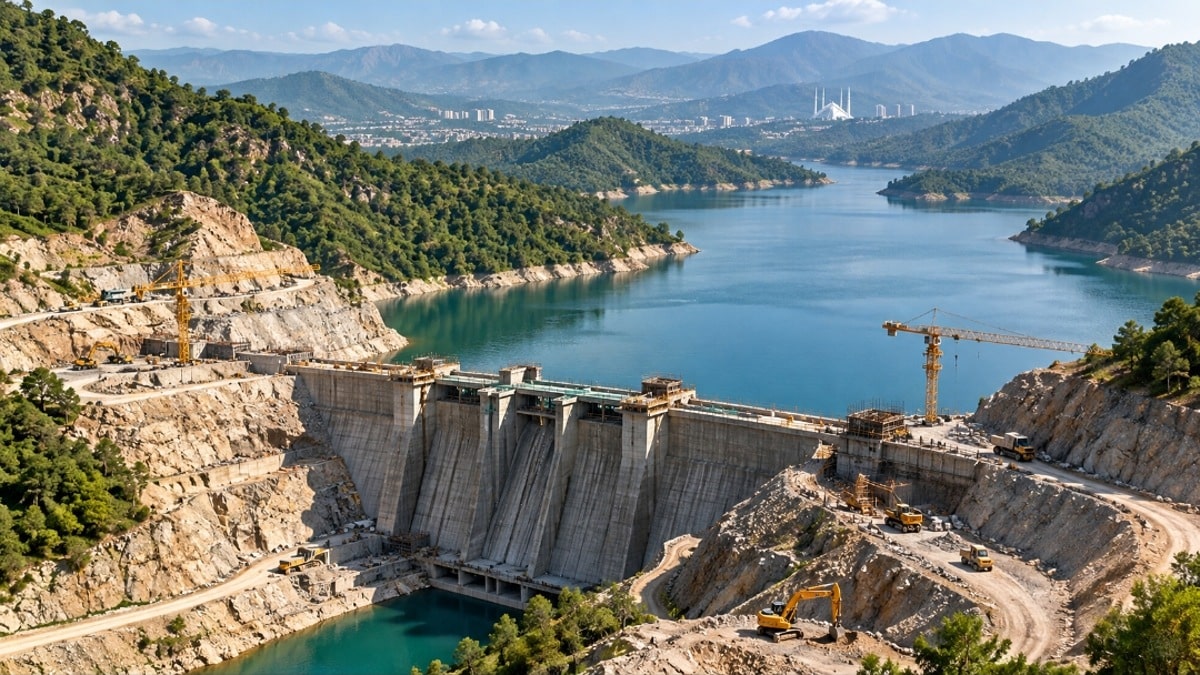
The estimated expenditure for two of Pakistan’s premier hydroelectric energy undertakings has expanded significantly, adding an aggregate Rs. 1.896 trillion to their overall financial projections. Official details presented by the Ministry of Water Resources to the National Assembly indicate that severe depreciation of the Pakistani rupee against the United States dollar, combined with sharp domestic price increases for critical materials, has drastically inflated the execution costs of both major ventures.
Diamer-Bhasha Dam Budget Rises Past Rs. 1.1 Trillion
The revised figures indicate that the anticipated cost for the Diamer-Bhasha Dam has climbed by Rs. 642 billion. Originally budgeted at Rs. 479 billion, the updated expenditure forecast now stands at Rs. 1.121 trillion. According to the Ministry of Water Resources, the upward revision is directly tied to structural changes in foreign exchange benchmarks. In response to these fiscal adjustments, authorities confirmed that a revised Planning Commission Proforma-I (PC-I) has been formally submitted to the Ministry of Water Resources to account for the enlarged capital requirements.
Dasu Hydropower Costs Climb 260 Percent
The financial expansion recorded at the Dasu Hydropower Project presents an even larger gap between early project models and current economic valuations. Estimates for the Dasu development expanded from an initial Rs. 486 billion to Rs. 1.740 trillion. This surge reflects a total increase of Rs. 1.254 trillion, marking a roughly 260 percent rise in projected obligations.
Commodity and Fuel Inflation Compound Fiscal Pressures
Beyond currency devaluation, government disclosures confirmed that broader market shifts across fuel and industrial construction components have driven significant financial pressure onto large-scale national infrastructure. Key material inputs have witnessed multi-fold price hikes during the execution timeline.
High-speed diesel recorded the steepest increase, surging by 472 percent from Rs. 72 per liter to Rs. 414 per liter. Industrial metals critical to heavy engineering experienced comparable trajectories: the price of steel and iron bars rose by 268 percent, increasing from Rs. 72,000 to Rs. 265,000 per metric ton. Similarly, standard cement prices climbed 204 percent, moving from Rs. 530 per bag to Rs. 1,610 per bag. The aggregate impact of these price movements has fundamentally shifted the capital requirements for both major energy generation programs.