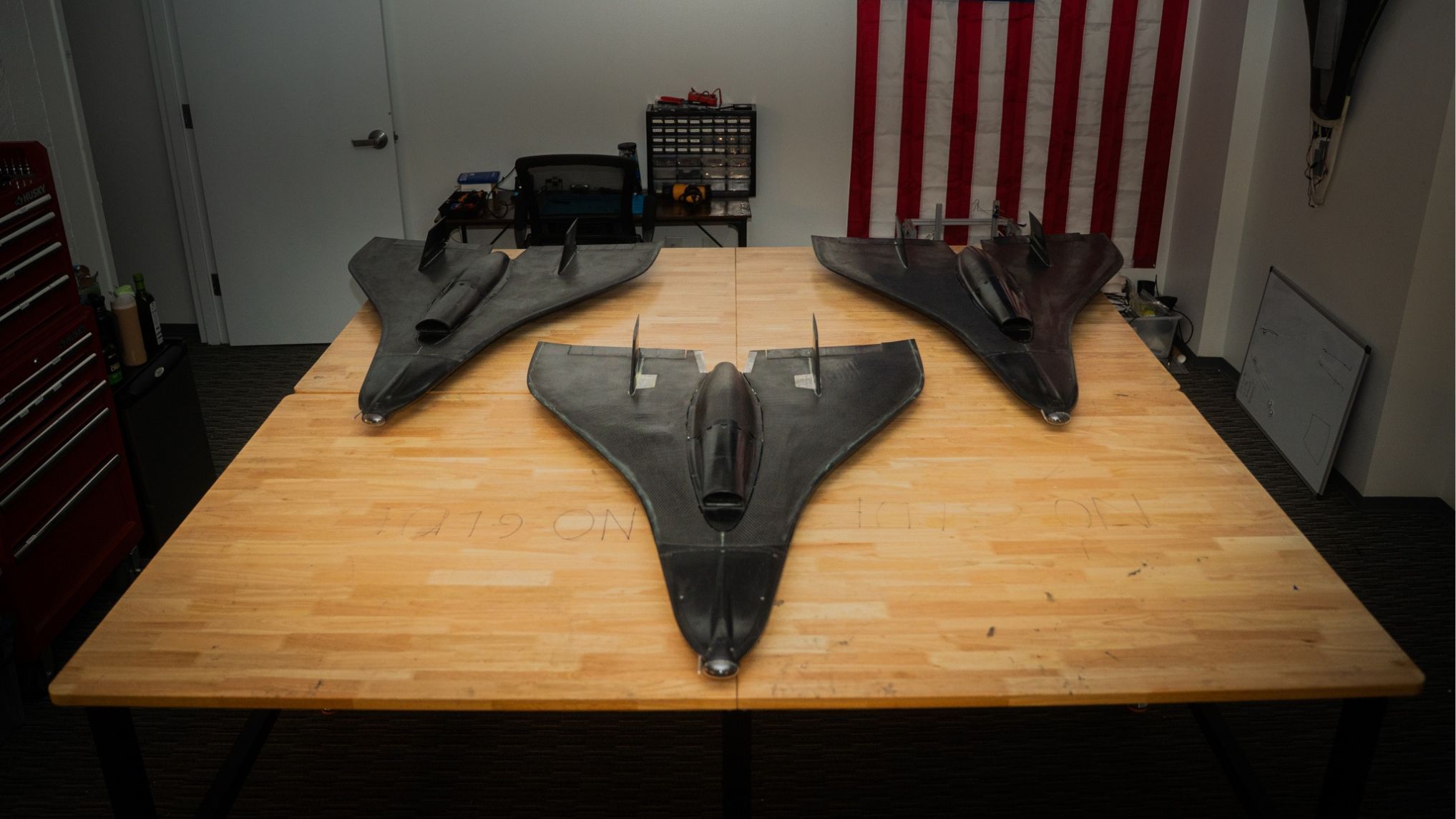
An undergraduate aerospace engineering student at the Georgia Institute of Technology has unofficially broken the world speed record for jet-powered remote-controlled aircraft after designing and constructing a high-speed drone inside his college dorm room. Tomas Salvo clocked a verified flight speed of 491 mph (790 km/h) with his custom unmanned aircraft, named Reaper, surpassing the longstanding previous world record of 465 mph set by Niels Herbrich.
The high-speed demonstration was conducted with the drone carrying an operational payload of 1.2 kilograms (2.6 pounds). While the flight marks a significant technical achievement in amateur aeronautics, Salvo’s run has not yet been officially certified by Guinness World Records. Nevertheless, the platform was engineered not simply as a one-off demonstrator, but as a repeatable system. Salvo has already constructed three Reaper airframes and reported that ongoing fine-tuning and aerodynamic adjustments could soon allow the design to exceed 800 km/h (500 mph).
Precision Dorm-Room Engineering
Assembling an aircraft capable of enduring the immense structural stresses of near-500-mph flight within a dormitory setting required specialized manufacturing techniques and careful weight management. The Reaper aircraft weighs just 11 pounds in total and cost approximately $13,000 to produce. Its outer airframe consists of a custom-molded carbon fiber shell, supported internally by a precision laser-cut structural skeleton designed entirely by Salvo.
Propulsion is supplied by a 250-Newton JetCat jet engine. To solve balance challenges without degrading performance, Salvo replaced the powerplant’s factory exhaust system with a custom titanium 3D-printed nozzle. This component enabled the engine to be mounted farther forward inside the fuselage, correcting the drone’s center of gravity without having to add deadweight ballast to the nose cone.
According to flight performance data shared by Salvo, Reaper can be deployed using either a rail-launch system or from a moving truck. Once airborne, the craft exhibits rapid vertical acceleration, climbing to an altitude of 2,000 meters (roughly 6,500 to 6,600 feet) in under 20 seconds. On a full fuel tank, Reaper can sustain its maximum velocity for up to four minutes, providing an effective operating range of 50 kilometers (31 miles) at full throttle.
Eyeing the $800,000 Boom Prize
Salvo’s project caught widespread attention online, eventually drawing the interest of Blake Scholl, founder and chief executive officer of Boom Supersonic. Scholl is sponsoring the Boom Prize, an $800,000 award composed of $750,000 in direct cash and $50,000 in Boom equity, designed to incentivize grassroots aviation innovators to achieve supersonic flight.
To claim the Boom Prize, a team must meet several strict flight parameters. The unmanned aircraft must break Mach 1—roughly 767.3 mph (1,234.8 km/h)—and sustain that speed for at least five seconds while flying level or in a climb, explicitly barring terminal dives. The propulsion system must be purely air-breathing, prohibiting the use of onboard oxidizers or rocket motors. Furthermore, the aircraft must land completely intact, and the exact same hardware—including the wings, fuselage, jet engine, and flight computer—must perform a second flight on the very same day.
The competition rules also govern participant eligibility, specifically targeting garage hobbyists and independent builders. Contestants must be individuals or private teams, strictly disqualifying entries backed by venture capital firms, corporate funding, or government grants. This stipulation raises open questions regarding how earlier sponsorship agreements that helped Salvo acquire his JetCat 250N engine will be evaluated under the competition’s amateur-only mandates. Following the prize announcement, Salvo turned to public crowdfunding, seeking $50,000 after previously securing $20,000 from undisclosed backers.
The Race to Mach 1
Reaper is not the only amateur jet project pushing the limits of small-scale aviation. Mach Initiative has been developing Kingchaser, a 3D-printed RC jet aircraft manufactured from PETG and powered by a larger 300N engine. While Kingchaser achieved 273 mph during an initial test constrained by limited runway space, its creators estimate the airframe could hit 550 mph under optimal conditions. However, because Mach Initiative’s members are not United States citizens, they are ineligible to win the Boom Prize, leaving them focused solely on capturing an official Guinness World Record.
Despite Reaper’s record-breaking run, a substantial engineering gap remains between 491 mph and the sound barrier. Both Reaper and competing platforms must gain nearly 280 mph to reach the Mach 1 threshold demanded by the Boom Prize challenge. For now, Salvo’s dorm-built Reaper stands as the fastest documented project of its kind in the United States, with further flight testing planned to close the distance toward supersonic speeds.