

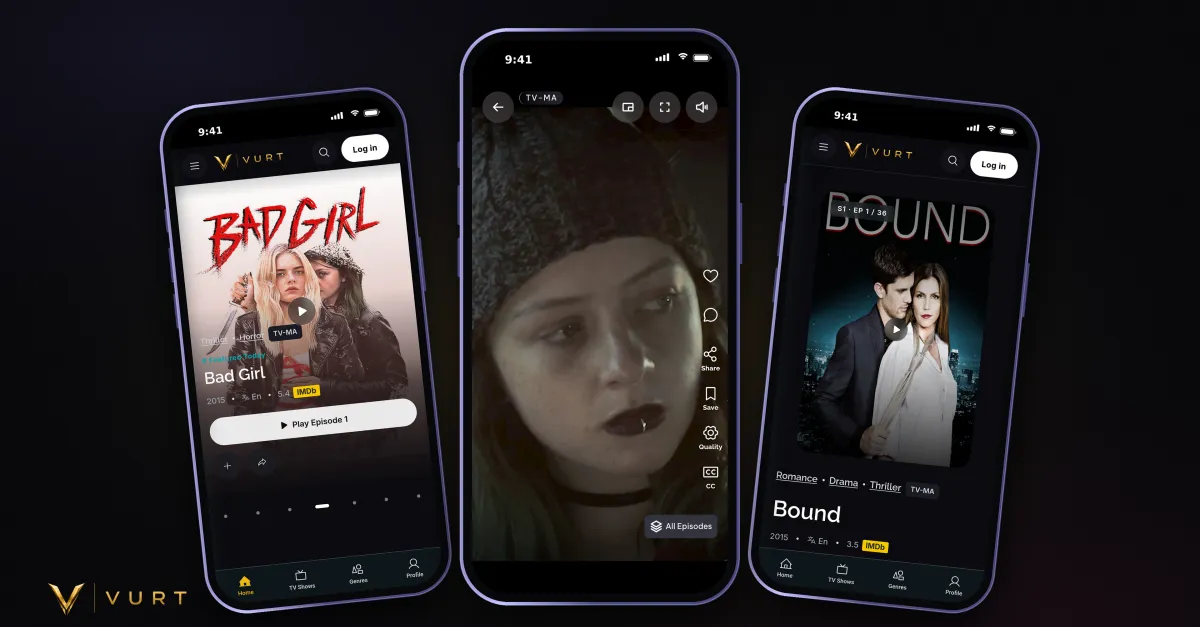
As major entertainment conglomerates from Disney Plus to HBO Max experiment with vertical video to counter the pull of platforms like TikTok and Instagram, one streaming startup is charting an unconventional route for the format. Instead of confining short, portrait-oriented video to mobile displays, Vurt is expanding its vertical microdrama catalog directly into the living room through native television applications.
The company recently deployed dedicated applications for Apple TV and Android TV, allowing viewers to access a catalog of approximately 3,500 episodes spanning more than 100 shows. Since its debut in March, Vurt has seen its registered audience surge from 10,000 to 675,000 users. While rival microdrama services have doubled down on smartphone interfaces, Vurt is betting that long-form television screens can serve as a viable home for rapid-fire serialized storytelling.
Pivoting from Mobile Casting to Dedicated TV Apps
Vurt co-founder and angel investor Hilmon Sorey noted that the expansion into smart TV hardware emerged directly from audience demand. Initially, users sought methods to beam mobile episodes onto living room monitors. While the platform initially supported screen casting from portable devices, engineering leadership decided that a native smart TV architecture would yield a far superior audiovisual experience.
Building standalone software for Apple TV and Android TV allowed the engineering team to leverage high-performance display processors, unlocking high-definition and 4K playback capabilities alongside upgraded audio processing. Sorey indicated that migrating from phone casting to purpose-built living room software eliminated latency hurdles while taking advantage of high-end home theater hardware.
The transition has also correlated with shifts in audience behavior. According to Sorey, engagement durations have risen among viewers accessing the catalog through television apps. By eliminating the necessity of handling a smartphone throughout an entire viewing session, the television interface allows audiences to consume consecutive episodes with fewer distractions.
Ad-Supported Streaming Versus Mobile Microtransactions
The microdrama industry has largely been dominated by international platforms such as DramaBox and ReelShort, which rely on episodic paywalls, in-app currency tokens, and gamified monetization schemes. Sorey voiced strong criticism against such mechanics, contrasting them with Vurt’s decision to maintain an entirely ad-supported, free-to-finish catalog.
Under Vurt’s structure, consumers do not encounter transactional paywalls to finish an episodic arc. Instead, monetization is driven entirely by corporate advertising partnerships. Sorey argued that pay-per-episode coin systems confuse and tax consumers, framing Vurt’s model as a fairer alternative for regular viewers.
On the production side, Vurt maintains licensing contracts with external studios and independent content makers based on a 50/50 revenue split. Independent creators who submit completed episodic work can see their projects cleared and published to the live network within days. Additionally, the startup emphasizes live-action production featuring human casts and production crews, deliberately contrasting itself with competitors that have flooded feeds with artificial intelligence-generated content.
The Vertical Aesthetic on Wide-Screen Hardware
Presenting vertical video on widescreen television hardware introduces obvious visual contrasts, with prominent black bars flanking the portrait display. However, Vurt argues that vertical storytelling functions as its own distinct medium rather than an awkward compromise.
Before introducing the living room apps, the company consulted creators about playback environments. While filmmakers typically value large-scale theater experiences, creators noted that vertical storytelling maintains high engagement regardless of whether it is viewed through earbuds on a phone or through speakers on a television. The narrative mechanics—defined by rapid-fire hooks, high melodrama, and relentless episode-ending cliffhangers—are built specifically to sustain attention across successive short installments.
The move arrives alongside broader industry efforts to push mobile formats into traditional media ecosystems. Platforms like Instagram have recently upgraded their television applications to incorporate Reels and Stories alongside horizontal programming. However, Vurt intends to maintain its primary focus on vertical framing, with future programming initiatives including newly commissioned original series and livestreamed sports coverage.