


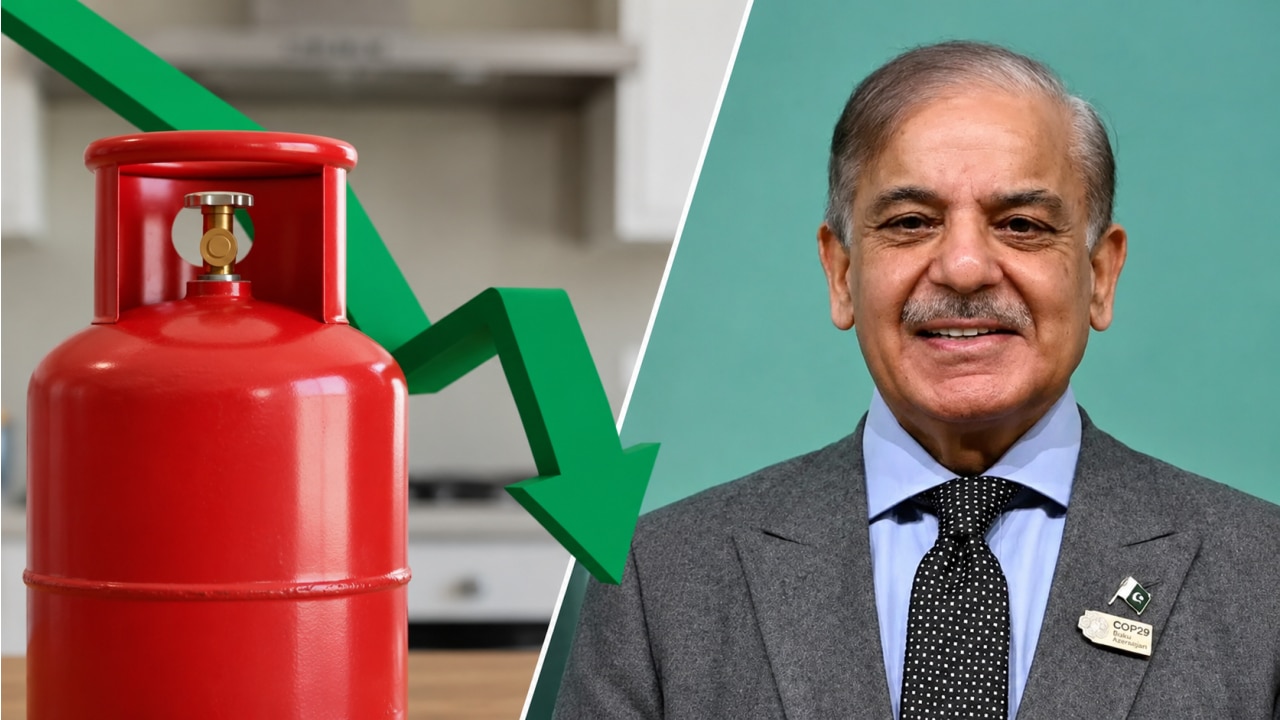
Prime Minister Shehbaz Sharif has constituted an eight-member ministerial committee to review sweeping reforms proposed for Pakistan’s liquefied petroleum gas (LPG) policy. The high-level intervention comes as consumer prices for an 11.57-kilogram LPG cylinder have spiked to between Rs. 6,000 and Rs. 7,200 across retail markets, drastically exceeding the official rate of Rs. 3,296 established by the Oil and Gas Regulatory Authority (OGRA).
The acute price escalation follows severe supply bottlenecks, triggered primarily by a suspension of border operations with Iran earlier this month alongside a decline in commercial cargo arrivals via maritime routes. In response to the market volatility, the federal government drafted regulatory revisions intended to transition procurement and price management toward state-owned enterprises (SOEs), a move that quickly met stiff resistance from private marketing companies, distributors, and dealers who protested the lack of prior stakeholder consultation.
Ministerial Committee Mandate and Timeline
The newly formed review body is headed by the petroleum minister and tasked with delivering a comprehensive report to the prime minister within one month. The panel is examining proposed structural changes to importation frameworks, local supply allocation models, and cylinder manufacturing standards before any final policy measures are executed.
Membership of the committee includes the minister for economic affairs, the minister for information, the prime minister’s adviser on interprovincial coordination, the special assistant on energy, the petroleum secretary, the director general of liquefied gases, and the head of the Government Relations Unit. The body’s evaluation follows the deferral of the draft policy, which had originally been scheduled to take effect within a single week.
State-Led Import Framework and Deregulation Proposals
Under the reform package under consideration, state-owned enterprises—including Pakistan State Oil (PSO), Sui companies, Pak-Arab Refinery Limited (PARCO), and Pakistan LNG—would assume responsibility for bulk LPG imports and lead the shift toward import parity pricing. The draft measures propose removing OGRA’s current statutory role in issuing price notifications for both domestic output and imported volumes, transferring pricing authority directly to SOEs before products pass into the private distribution network.
The mechanism would preserve monthly adjustments, calculating baseline tariffs against Saudi Aramco’s free-on-board (FOB) contract price (CP) adjusted for propane-butane ratios. The formula would also integrate actual premiums, ocean freight, insurance, incidental logistics, and import taxes registered during the previous month. If SOEs do not execute direct imports in a given cycle, prior-month incidentals and premiums would apply alongside the current CP, mirroring the pricing framework currently utilized for retail petrol and high-speed diesel.
To accelerate commercial transactions and draw larger trading entities, a cabinet summary has additionally recommended exempting bidding submissions from mandatory public posting on the Public Procurement Regulatory Authority (PPRA) website, citing operational urgency.
Targeted Subsidies via the Producer Price Differential Fund
A central component of the restructuring framework involves establishing a Producer Price Differential Fund maintained within a dedicated federal Public Account. Domestic refineries and producers would be required to deposit the monetary spread between locally produced LPG rates and imported parity pricing into this reserve.
Monitored and audited by the Auditor General of Pakistan, the accumulated capital would be deployed by the federal government to finance targeted consumer relief. Direct subsidies would be distributed to vulnerable low-income households utilizing the Benazir Income Support Programme (BISP) poverty scorecard.
Regarding supply distribution, the policy outlines a split allocation system for domestic output. Ten percent of indigenous LPG production would be directed to state-owned marketing entities at baseline producer prices to guarantee fuel access for Gilgit-Baltistan, the Northern Areas, and remote territories through cylinders and air-mix facilities. The remaining 90 percent of domestic volumes would be distributed among prequalified bottling firms via monthly auctions, anchored by a minimum floor price set at 5 percent of PSO’s import parity benchmark.
Stakeholder Pushback Over Sourcing and Margins
Private sector operators have raised significant concerns regarding the feasibility of the proposed overhaul. Industry representatives argue that state-owned entities lack sufficient operational experience in managing dedicated LPG import logistics. Furthermore, dealers warn that proposed levies on indigenous production could exacerbate consumer price inflation instead of curbing it.
Market participants also dispute the benchmarking of import pricing against Saudi Aramco’s contract price, pointing out that the vast majority of Pakistan’s commercial LPG supplies are traditionally imported overland or by sea from regional sources including Iran and Oman rather than Saudi terminals.
Addressing distribution economics, the draft framework proposes increasing regulated marketing and importing company margins from the existing Rs. 35,000 per tonne to a minimum of Rs. 50,000 per tonne. Proponents view the adjustment as necessary inflation relief, noting distributor margins have remained unchanged since the enactment of the 2016 LPG policy. The revised margins would remain subject to market competition, with OGRA and the Competition Commission of Pakistan assigned oversight to detect and deter anticompetitive collusion.