


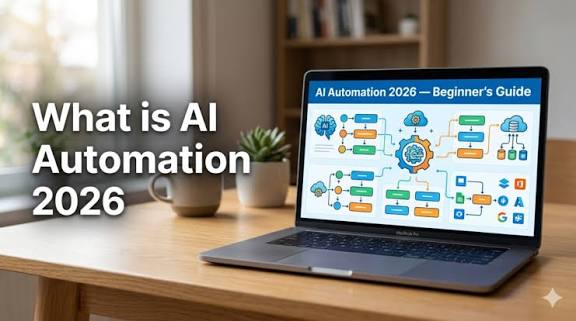
What Is AI Automation?
Artificial intelligence is rapidly changing the way businesses work, and AI automation has become one of the most important developments in the technology industry. By combining artificial intelligence with automated workflows, businesses can allow software to understand information, make decisions and complete tasks with far less human involvement.
Unlike traditional automation, which normally depends on fixed rules, AI automation can handle information such as emails, documents, customer messages and other unstructured data. This makes it useful for business processes that previously required employees to manually analyze information and decide what to do next.
According to Make, AI automation combines AI capabilities with automation workflows to create systems that can interpret information and take appropriate actions.
How Does AI Automation Work?
AI automation generally works by connecting an AI model to a workflow containing different applications and actions.
A typical process can look like this:
Trigger → AI analyzes information → Decision → Action
For example, when a company receives a customer email, an AI system can read the message, identify the customer’s problem, determine its priority and generate an appropriate response.
The workflow can then automatically send the response, update a customer database or forward the issue to an employee if human assistance is required.
This combination of AI and automation allows businesses to move beyond simple repetitive tasks and create workflows capable of handling more complex situations.
AI Automation vs Traditional Automation
Traditional automation usually operates according to predefined instructions.
For example:
If a customer submits a form → send a confirmation email.
The system does not need to understand what the customer wrote. It simply follows the rule.
AI automation adds an intelligence layer to the process.
For example:
Customer sends an email → AI understands the request → identifies the customer’s intention → generates an appropriate response → updates the relevant system.
This ability to interpret information makes AI automation particularly useful for modern businesses dealing with large amounts of unstructured data.
AI Automation and AI Agents
AI automation is also closely connected to the growing development of AI agents.
A conventional AI-powered workflow usually follows a predefined structure. An AI agent can have greater flexibility and may determine which tools or actions are required to achieve a particular goal.
For example, instead of simply generating a sales email, an AI agent could research a potential customer, analyze available information, prepare a personalized message, update a CRM and schedule a follow-up.
This represents a shift from automation that simply executes instructions toward systems that can participate more actively in completing business objectives.
Where Is AI Automation Being Used?
AI automation is already being applied across numerous industries and business departments.
Sales
Sales teams can use AI automation to analyze incoming leads, identify promising prospects, summarize customer conversations and create personalized follow-up messages.
Automated workflows can also update CRM systems whenever a new interaction takes place.
Marketing
Marketing teams can use AI to generate content ideas, repurpose existing material, analyze customer responses and automate parts of email and social-media campaigns.
A single piece of content, for example, can be transformed into multiple formats automatically.
Customer Support
AI automation can analyze incoming support requests and categorize them based on topic, urgency and customer sentiment.
Simple questions can receive automated responses, while more complicated issues can automatically be escalated to human support agents.
Finance
Financial teams can use AI automation to extract information from invoices, categorize expenses, process documents and identify unusual transactions.
This can reduce repetitive administrative work and allow employees to concentrate on higher-value financial activities.
Human Resources
HR departments can use AI automation for tasks such as organizing applications, summarizing candidate information, scheduling interviews and answering frequently asked employee questions.
However, human involvement remains important when decisions could significantly affect employees or applicants.
Benefits of AI Automation
The growing adoption of AI automation is largely driven by its potential to improve efficiency and reduce repetitive work.
Increased Productivity
Automated systems can handle repetitive processes while employees focus on more strategic responsibilities.
Faster Operations
AI-powered workflows can process information and trigger actions much faster than many manual processes.
Greater Scalability
Businesses can handle increasing workloads without necessarily increasing the amount of manual labor at the same rate.
Better Data Processing
AI can analyze large amounts of text and other unstructured information and convert it into useful data for business systems.
More Consistent Workflows
Automated processes can follow standardized procedures, reducing certain types of manual mistakes.
What Are the Risks of AI Automation?
AI automation also introduces new challenges.
AI models can produce incorrect information, misunderstand instructions or make inappropriate decisions. Businesses also need to consider data privacy, cybersecurity, bias and compliance.
Another important issue is human oversight. Not every process should be completely automated, particularly when decisions involve money, employment, sensitive personal information or significant customer consequences.
Organizations should therefore establish approval systems and monitoring mechanisms before deploying AI automation at scale.
How Can a Business Start Using AI Automation?
Businesses do not need to automate everything immediately.
A better approach is to identify repetitive processes that consume significant employee time.
The process can then be evaluated based on:
- How frequently the task occurs
- How much manual work it requires
- Whether AI can reliably interpret the information
- What systems need to be connected
- Whether human approval should remain part of the workflow
Starting with a low-risk process allows a business to measure the results before expanding automation to more complex operations.
The Future of AI Automation in 2026
AI automation is moving toward increasingly intelligent systems capable of handling multiple stages of a workflow.
Instead of simply asking AI to write an email or summarize a document, businesses are beginning to explore systems that can analyze a situation, choose the appropriate tools, complete several actions and report the outcome.
This development could make AI automation an important component of business operations throughout 2026 and beyond.
Final Thoughts
AI automation is changing the traditional concept of workplace automation. Instead of software simply following fixed instructions, AI-powered systems can interpret information, make decisions and take action.
Its applications range from sales and marketing to customer service, finance, HR and business operations.
However, successful AI automation is not about replacing humans in every process. The strongest approach combines AI’s speed and scalability with human judgment, creativity and accountability.
As businesses continue adopting artificial intelligence in 2026, understanding how AI automation works and where it can create genuine value will become increasingly important for companies looking to improve productivity and remain competitive.
About The Author