


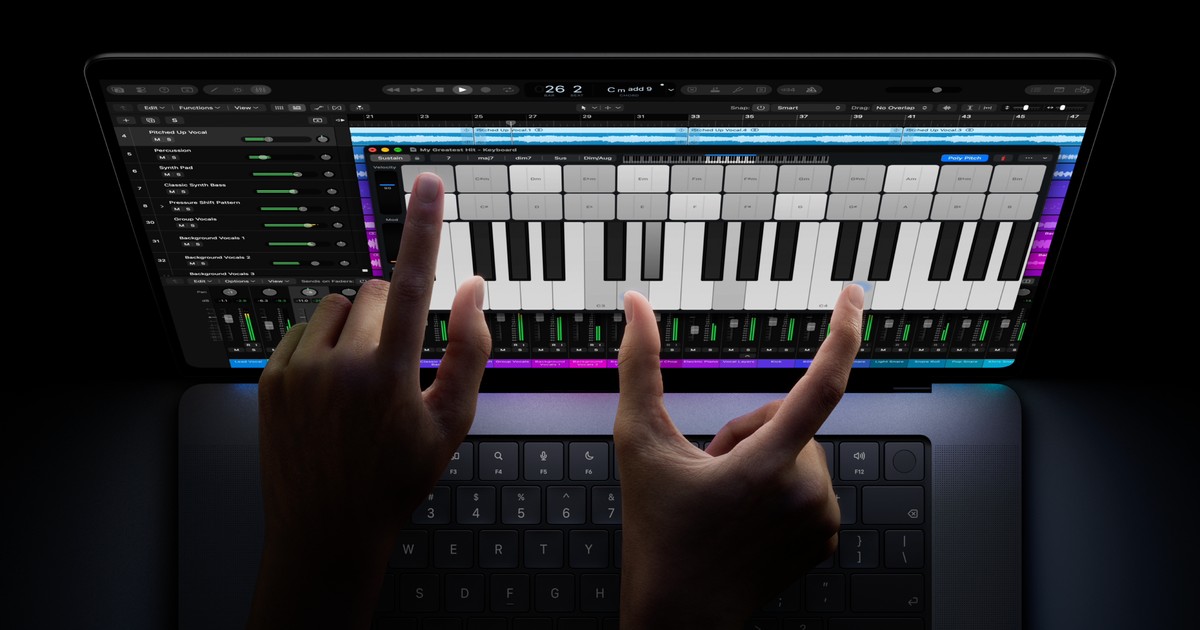
Apple has officially announced an overhaul of its flagship professional laptop lineup, introducing the new 14-inch and 16-inch MacBook Pro powered by M5 Pro and M5 Max processors. The updated models feature the debut of Apple’s PROLED XDR display based on tandem OLED technology, built-in multi-touch capabilities integrated directly into the screen, the arrival of the Dynamic Island to the Mac, and a redesigned chassis that reduces overall weight and thickness while extending battery life up to 24 hours.
Pre-orders for the hardware commence on October 28, 2026, with retail and online availability beginning on Friday, November 6.
Tandem OLED Architecture and PROLED XDR
At the center of the revision is the PROLED XDR display, which integrates tandem organic light-emitting diode (OLED) layers with proprietary algorithms within Apple’s display engine. The hardware reaches up to 2,000 nits of peak brightness for both standard dynamic range (SDR) and high dynamic range (HDR) workflows. By utilizing tandem OLED panels alongside custom compensation methods, the screen achieves a 10,000,000:1 contrast ratio to preserve shadow detail without backlight blooming.
For color-sensitive tasks, the display broadens standard wide color support. Beyond standard P3 coverage, the panel now covers Adobe RGB with extended reach into cyan and green spectra, alongside greater than 80 percent coverage of the Rec. 2020 color space for high-end HDR mastering. Both P3 and Adobe RGB can be accessed via a single default display preset. Factory calibration maps luminance, white points, and color gamut targets to reference specifications. Users working in environments with severe ambient lighting can also opt for an etched nano-texture glass finish designed to mitigate glare. Adaptive ProMotion refresh rates scale from 10Hz to save battery up to 120Hz for high-frame-rate interaction.
Direct Touch Input and Redesigned Chassis
For the first time on a Mac, the display integrates native Touch capabilities. Rather than using an external digitizer overlay, touch sensors are fabricated directly inside the display stack to minimize input latency. The operating system natively maps touch inputs to clicks, enabling existing software to function immediately without manual developer intervention. Pro workflows accommodate direct canvas drawing for graphic designers, onscreen software instrument performance for musicians, and live touch testing for iOS and iPadOS developers.
Apple also modified the structural mechanicals to accommodate physical interaction. A redesigned display hinge increases rigidity during direct finger contact, while the built-in 12MP Center Stage camera incorporates active real-time video stabilization to suppress camera shake during video calls when the screen is touched.
The transition to OLED allows for thinner display stacks, trimming physical bulk. The 14-inch model now weighs 3 pounds (a half-pound reduction) and measures half a millimeter thinner, housing a 14.2-inch panel. The 16-inch model drops 0.7 pounds to an even 4 pounds, measures roughly one millimeter thinner, and features an expanded 16.3-inch screen enabled by reduced border margins. Both variants contain a revamped internal thermal architecture designed to direct hot exhaust away from the display while sustaining heavy processing loads.
M5 Pro, M5 Max, and AI Compute
Under the hood, the notebooks run on Apple’s next-generation silicon: the M5 Pro and M5 Max. The chips pair updated CPU architectures and faster unified memory architectures—configurable up to 128GB, alongside solid-state storage options scaling up to 16TB. Each GPU core incorporates a dedicated Neural Accelerator designed specifically to speed up local AI execution, enabling tasks such as running on-device coding agents and local large language models. The M5 Max is specifically engineered to handle complex on-device LLMs containing hundreds of billions of parameters.
Graphics capabilities also receive an overhaul through a third-generation hardware-accelerated ray-tracing engine, enhanced shader cores, and Dynamic Caching memory management to improve GPU utilization across demanding engines like Blender, Unreal Engine, and Cinema 4D.
“The new MacBook Pro with PROLED XDR Display is a monumental step forward for the Mac,” said Johny Srouji, Apple’s chief hardware officer, highlighting the integration between the tandem OLED display engine, Apple silicon, and touch capabilities.
macOS 27, Dynamic Island, and Ecosystem Features
The hardware runs on macOS 27, which incorporates the Dynamic Island at the top of the display. Serving as an interactive hub, it houses Spotlight search, Live Activities, and Siri AI. Users can track background actions, manage media, or interact with notifications through touch. Siri AI integrates across system menus and Spotlight, utilizing on-device personal context to retrieve items across photos, messages, and emails, while a dedicated shortcut triggers Visual Intelligence to inspect items directly on the screen. Apple Intelligence also introduces automatic Safari tab sorting, custom extension generation, and descriptive Shortcuts automation creation.
Port selection across the chassis includes three Thunderbolt 5 ports, an HDMI connection, an SDXC card reader, MagSafe charging, and a 3.5mm headphone jack. Display output tops out at three external monitors with M5 Pro and four monitors with M5 Max. Wireless connectivity includes Wi-Fi 7 and Bluetooth 6. Fast charging replenishes up to 50 percent battery capacity within 30 minutes. The internal audio array features a six-speaker system with newly engineered woofers that extend bass response by 50 percent, accompanied by specialized closed-lid audio tuning when operating in clamshell mode connected to external monitors.
On the sustainability front, Apple stated the machines contain 55 percent recycled material overall. This includes 100 percent recycled aluminum in the enclosure, 100 percent recycled cobalt in the battery cells, and 100 percent recycled tantalum within multiple onboard capacitors, with 45 percent of supply chain manufacturing powered by renewable energy sources.