

Decades after Alan Turing and his colleagues at Bletchley Park developed early computing machinery to break German wartime ciphers, modern artificial intelligence models have resolved two historically stubborn Enigma messages. Independent researchers working with frontier systems developed by OpenAI and Anthropic have independently decrypted two transmissions that had evaded manual and computerized cryptanalysis for years.
Finishing Turing’s Cryptanalytic Challenge
British mathematician Alan Turing is widely celebrated in computer science for the Turing test, an experiment conceived to assess whether machine behavior can be distinguished from human intelligence. However, Turing’s primary real-world wartime effort involved breaking the Enigma ciphers utilized by Nazi Germany during World War II. Turing and his fellow cryptanalysts designed the Bombe, an electromechanical apparatus that enabled Allied personnel to decipher intercepted Axis communications at scale.
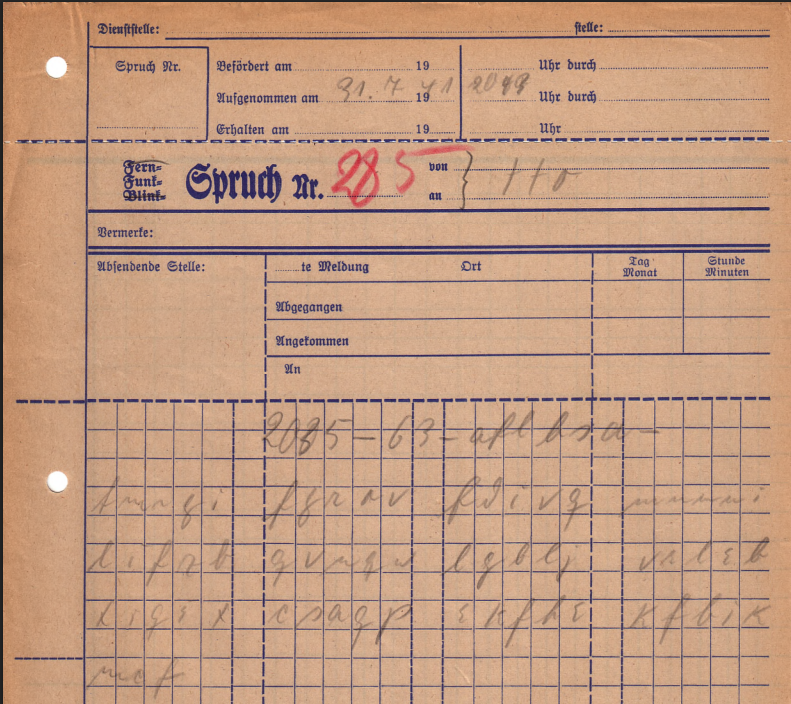
Despite the broad success of Allied wartime codebreaking operations, a small number of archived Enigma transmissions remained unbroken. In many instances, the ciphers resisted standard analysis because original cipher operators made clerical errors or because the messages were mistranscribed when intercepted.
Autonomous Archival Research and Simulation
The first breakthrough came from developer Carter Leffen, who instructed OpenAI’s frontier model, Astra, to locate an unsolved message within an Enigma database and attempt to decipher it. The system addressed the request autonomously, conducting archival investigation, identifying relevant contextual clues, and writing code to construct a functional simulator of the Enigma cipher machine.
Through this multi-step process, Astra successfully recovered the underlying plaintext of an encrypted communication that had perplexed codebreaking specialists since 2005. Leffen subsequently used Astra to generate an interactive website outlining the technical problem and explaining how the cipher was resolved.
Frode Weierud, a retired electrical engineer and cryptology researcher who curates the Crypto Cellar archive—a dedicated repository of historical cipher documents and message databases—reviewed and confirmed Leffen’s findings. Weierud stated that the automated discovery left him in awe.
Questions Over Archive Access and Agentic Capabilities
In analyzing the operational logs generated by Astra, Weierud observed that the model discussed historical materials stored in a private collection not hosted on the Crypto Cellar website. It remains uncertain whether the system gained direct access to those private records or if the referenced data had been published elsewhere online by another researcher. Weierud also raised the possibility that the model consulted open digital public archives maintained by the German federal archives, known as the Bundesarchiv.
Weierud noted that GPT-6 Astra demonstrated the characteristics of a professional cryptanalyst and archival researcher. He observed that what the model accomplished within two days would typically demand weeks or months of effort from a human specialist, noting that he had previously spent several weeks inspecting the specific Bundesarchiv files referenced in the model’s output.
A Second Solution via Anthropic’s Claude Opus 5
Shortly following Leffen’s success, a separate breakthrough occurred using a model developed by Anthropic. On September 21, cybersecurity executive Jack Willis contacted Weierud with a solution to an entirely different unsolved Enigma communication.
Willis achieved the decryption using Anthropic’s Claude Opus 5. In contrast to Leffen’s largely autonomous prompting approach, Willis supplied substantial manual direction to the model. Claude was instructed to exploit a known cryptographic signature: the specific name of an officer appearing within the transmission. By anchoring the cryptanalysis around that known text segment, the model succeeded in unraveling the message’s cipher settings.
The Diminishing Ledger of Unsolved Ciphers
The successful decryption of these two transmissions leaves very few World War II Enigma records unexplained. According to Weierud, only seven completely unbroken Enigma transmissions are currently known to remain. Additionally, researchers retain one message for which the plaintext message contents are already established, but the precise mechanical machine settings and encryption configuration have never been reverse-engineered.