Artificial intelligence is changing the way video games are developed, but its growing capabilities are also creating new challenges for the gaming industry. From recreating classic titles to building playable versions of popular games, AI-powered coding tools are making tasks that once required months of development increasingly accessible.
However, not everyone in the gaming industry is happy with this development.
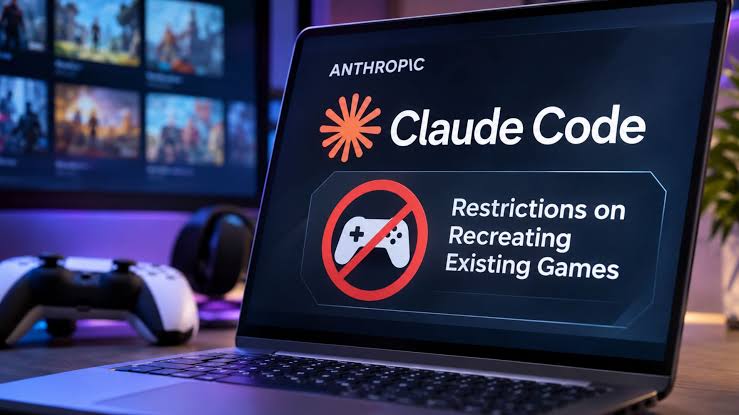
Anthropic, the company behind the AI chatbot Claude, has introduced new restrictions designed to prevent its coding assistant from recreating specific existing video games. The decision comes amid growing concerns about AI-generated game copies, intellectual property violations and the impact of these technologies on independent game developers.
The update specifically targets Claude Code when used with its Opus 5.5 model. While developers can still use the AI tool to build original games, the company wants to prevent users from asking it to reproduce identifiable games belonging to other creators.
Why Has Anthropic Introduced Restrictions on Claude?
The new restrictions follow reports of AI tools being used to recreate existing video games through reverse engineering and automated coding.
Traditionally, recreating a video game requires significant technical knowledge, programming experience, artistic resources and considerable development time. AI coding assistants have started reducing these barriers, allowing users to experiment with existing game mechanics and recreate recognizable gaming experiences with comparatively less effort.
This has raised concerns among independent developers, particularly those working on smaller projects with limited budgets.
Some developers have reportedly become worried about sharing unfinished game demos publicly because someone could potentially use AI tools to create a similar version before the original game is even released.
According to industry reports, several independent studios have faced concerns about their unfinished projects being copied. In some cases, developers have even reconsidered public playtests to protect their original work.
Anthropic’s latest decision appears to be an attempt to address these concerns before AI-assisted game cloning becomes an even bigger problem.
What Exactly Has Changed in Claude Code?
The restriction was initially noticed by an X user known as Chasm, who identified new instructions within Claude Code around October 27, 2026.
The instructions, reportedly associated with an internal rule called “tengu_heron_brook”, tell Claude to support original game development while refusing requests to recreate specific existing games, even if users rename them or describe them as original projects.
Anthropic’s engineering leader Addy Osmani later confirmed the change publicly on October 30.
He explained that the company had added two sentences to Claude Code’s prompt on Opus 5.5 to guide the AI away from recreating someone else’s specific game because using Claude to infringe intellectual property violates the company’s usage policy.
The announcement also clarified that the restriction is not intended to stop legitimate game development.
Developers can still use Claude to:
- Build completely original video games.
- Create games inspired by general gaming genres.
- Develop projects using their own designs and assets.
- Experiment with original gameplay mechanics and concepts.
In simple terms, creating a new racing game is still allowed, but asking Claude to reproduce a particular existing racing title is where the restriction becomes relevant.
Developers Are Also Reporting False Positives
Although Anthropic’s decision is intended to protect game creators, it has also created frustration among some developers.
Several users have reported that Claude Code is refusing certain legitimate game-development requests. These include ordinary debugging activities, reverse-engineering tasks and work involving projects that developers claim to own.
This creates an important problem for AI companies: how can an AI system reliably distinguish between someone attempting to steal another developer’s work and someone legitimately working on their own project?
For example, a developer might want to recreate a particular gameplay mechanic for testing purposes or analyze an existing system as part of an authorized development project.
An automated restriction may not always understand the difference.
Addy Osmani acknowledged the possibility of incorrect refusals and invited developers whose legitimate projects are being blocked to report their experiences.
Anthropic has also indicated that it will continue adjusting the restrictions to find a better balance between protecting intellectual property and supporting legitimate creative work.
What Does This Mean for the Future of AI Gaming?
The decision highlights a much bigger discussion about the relationship between artificial intelligence and the creative industries.
AI coding tools are becoming powerful enough to help people build software, applications and video games without extensive programming experience. This creates opportunities for independent developers, students and small studios that previously lacked the resources to compete with larger gaming companies.
However, the same technology can also make unauthorized copying easier.
For independent game developers, their original concepts, artwork, characters and gameplay systems can represent years of work. If AI tools make it easier for others to reproduce those projects, protecting creative ownership becomes increasingly important.
At the same time, Anthropic’s restrictions alone are unlikely to eliminate AI-powered game cloning. Developers can potentially turn to other AI models, including open-weight systems, that may not have similar restrictions.
This means the issue extends beyond one company or one coding assistant. It raises questions about how the entire AI industry should handle copyrighted material and the use of existing creative works.
The Bigger Picture
Anthropic’s latest move represents an important step towards establishing boundaries for AI-assisted software development.
The company is attempting to maintain the benefits of AI-powered game creation while discouraging the unauthorized recreation of existing titles.
However, finding the right balance will not be easy. Too few restrictions could expose independent creators to greater risks, while overly aggressive safeguards could prevent legitimate developers from using AI tools effectively.
For now, Claude Code users can continue building original gaming experiences, but recreating specific existing video games is no longer something Anthropic wants its AI assistant to facilitate.
The bigger question is no longer whether AI can build video games. It is whether the technology can help create the next gaming masterpiece without copying someone else’s.