Ambi, an artificial intelligence startup founded by former Plaud executive Peter Mo, has secured $26 million across multiple funding rounds to build software and hardware capable of continuous background listening. The capital infusion comes as tech companies increasingly embrace ambient intelligence, betting that around-the-clock context gathering will unlock more useful, personalized digital assistants.
The investment rounds were led by venture capital firm Luminous Ventures, an investor known for backing companies such as on-demand giant Meituan and robotics developer Unitree Robotics, alongside original design manufacturer Huaqin. With the fresh funding, Ambi is launching applications across Apple platforms, expanding its engineering footprint, and laying the groundwork for a dedicated hardware ecosystem.
Expanding Beyond Traditional Meeting Recorders
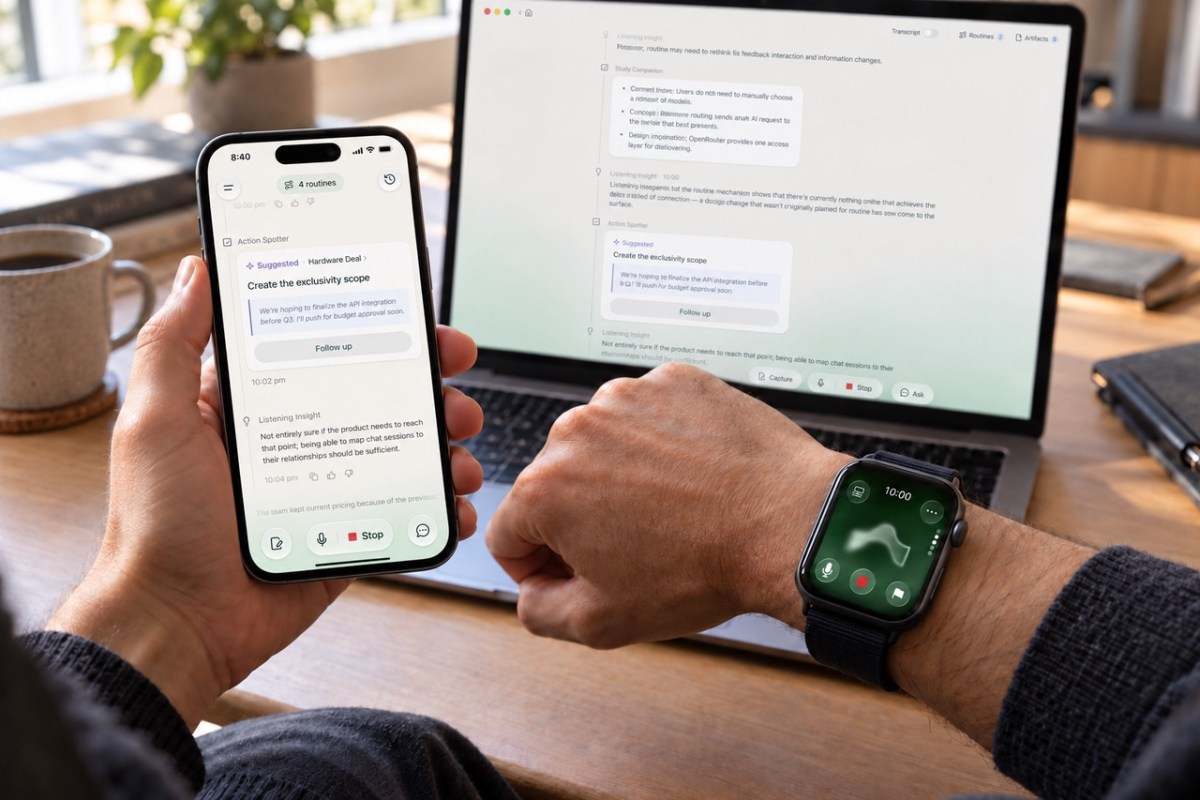
Ambi is introducing apps for iPhone, Mac, and Apple Watch that serve as ambient capture tools. While conventional AI meeting assistants record audio during scheduled calls and generate post-meeting summaries or action items, Ambi aims to alter that workflow by intervening while discussions are still actively underway.
The startup’s AI agent is designed to proactively surface relevant knowledge and offer targeted suggestions during meetings. To do this, the system draws on several contextual sources simultaneously, including the user’s calendar, historical meetings, internal knowledge bases, and web data. Users can also transfer ongoing workflows across hardware environments, beginning an inquiry or task on one device and continuing it seamlessly on another.
Mo, who serves as Ambi’s chief executive officer, previously worked at Plaud, a company known for its voice-recording hardware cards. According to Mo, existing hardware and software configurations introduce too much friction to deliver genuinely responsive intelligence to users throughout their workday.
“The way we interact with intelligence is limited. Often the intelligence is trapped on the screen, and if you use hardware like Plaud, you need to wait for recording to transfer to the phone, upload to the cloud, and get intelligence after processing,” Mo said. “That’s why we are building Ambi to use AI anytime and anywhere.”
Desktop Memory and Hardware Ambitions
Beyond audio capture, Ambi plans to broaden the types of contextual data its software monitors. An upcoming desktop application will monitor on-screen activity and store notable fragments in memory to inform future personalized suggestions, a concept already being explored by desktop tools such as Littlebird and Minimi.
Ambi also intends to release standalone consumer hardware. The startup is developing a device outfitted with microphones, a camera, a speaker, and a display screen, engineered specifically to observe environmental context and present real-time information to the user.
The company currently employs more than 50 staff members distributed across offices in San Francisco, Beijing, Shanghai, and Shenzhen. Mo confirmed that Ambi is using its latest capital to recruit staff for go-to-market roles as well as specialized AI engineers focused on training and optimizing speech-recognition models.
Privacy Challenges and Third-Party Disclosure
The rise of continuously listening digital agents has intensified ongoing scrutiny around privacy, wiretapping laws, and bystander consent. Across the technology sector, several meeting notetaker developers have faced legal challenges after their platforms captured conversations involving individuals who had not consented to being recorded. Recent industry developments, including Apple’s continuous Audio Intelligence transcription feature, have similarly attracted privacy criticism.
A critical issue facing ambient capture technology is the absence of conspicuous indicators alerting bystanders that microphones are active. It remains unclear whether Ambi’s newly launched software or its planned standalone device will feature visible indicators to inform third parties that conversations are being monitored if the primary user does not disclose the recording.
Addressing these concerns, Mo stated that ambient listening is disabled by default within Ambi’s platform and that users can turn off continuous recording at any time. The company additionally noted that it encrypts captured data and does not store user audio recordings, though it did not publicly disclose the specific encryption standards or technical protocols deployed.
Nevertheless, the responsibility for notifying non-consenting parties ultimately remains with the user, a reality Mo described as a broader dilemma facing the artificial intelligence sector.
“We have to inform our users that they have to tell others about ambient capture. We, as an industry, haven’t solved this problem of disclosure,” Mo said. “We have tried to put the information about disclosure in every place possible, but if users try to hide the capture, we can’t just solve the problem.”