


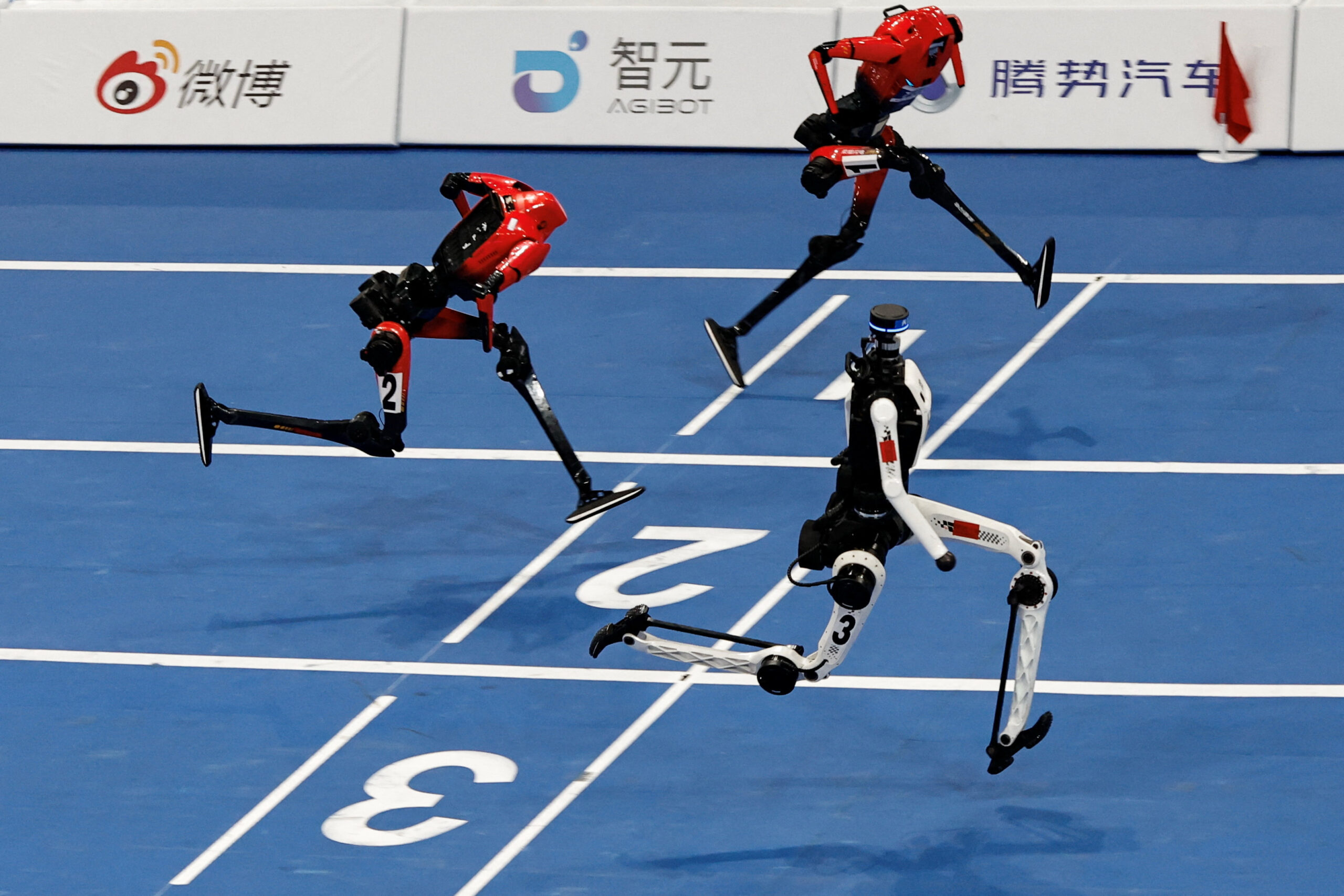
Humanoid robots have entered a new phase in their development after a Chinese robot completed the 100-meter sprint in 8.64 seconds, beating Usain Bolt’s human world record of 9.58 seconds by nearly one second.
The record was set by Tiangong Ultra at the 2026 World Humanoid Robot Games in Beijing, where more than 2,000 robots competed across 51 categories. The event demonstrated how quickly robotics is advancing, particularly in areas such as movement, balance, coordination and embodied artificial intelligence.
But the most important question is not whether a robot can run faster than a human.
It is what these machines will be able to do outside the stadium.
The Robot That Outran Usain Bolt
Tiangong Ultra, developed by the Beijing Humanoid Robot Innovation Centre, recorded a remarkable 8.64-second 100-meter sprint during the final day of the competition.
For comparison, Usain Bolt’s legendary human record stands at 9.58 seconds, achieved in Berlin in 2009.
The robot’s performance also represented a major improvement over earlier runs at the same event. Tiangong Ultra had previously recorded times of 9.39 seconds and 8.86 seconds before reaching 8.64 seconds in the final.
The achievement has attracted worldwide attention because humanoid robots are increasingly moving beyond simple demonstrations and beginning to perform complex physical tasks.
However, the comparison with human athletes needs some context. Robots and humans operate under very different physical constraints, and a sprinting robot does not possess the same biological limitations as a human runner.
Beijing’s Robot Games Show How Fast Robotics Is Moving
The 2026 World Humanoid Robot Games brought together more than 2,000 robots from 666 teams, with participants from 16 countries.
The competition included events such as sprinting, soccer, boxing, jumping and table tennis. But the event was not designed simply as entertainment.
Many competitions were intended to demonstrate capabilities that could eventually have practical applications in factories, warehouses, homes and other environments.
That makes the event particularly significant for the robotics industry.
Sports provide engineers with controlled environments where they can measure a robot’s speed, stability, reaction time and coordination. Every failure also provides valuable information that can be used to improve future hardware and software.
Speed Is Impressive — But Control Is More Important
The viral sprinting footage may be the biggest attraction, but robotics researchers are increasingly focused on something more difficult than running.
Dexterity.
A robot that can run 100 meters quickly still needs to learn how to safely interact with the world around it.
At the Beijing competition, robots also performed practical tasks involving household work, hotel services, emergency response and object manipulation. These challenges test abilities that are much closer to what commercial humanoid robots will eventually need.
Picking up an object without damaging it, plugging in a cable, moving items onto a shelf or navigating an unpredictable workspace can be considerably more difficult than following a predefined sprinting route.
This is where the next major robotics breakthrough could happen.
The Rise of Physical AI
The development of humanoid robots is closely connected to a broader technological trend known as physical AI or embodied AI.
Traditional AI systems operate primarily through computers and digital environments. Physical AI combines artificial intelligence with machines that can perceive their surroundings and physically interact with them.
Humanoid robots could eventually use cameras, sensors, AI models and advanced control systems to understand environments and perform tasks without requiring constant human instructions.
That could transform industries ranging from manufacturing and logistics to healthcare and domestic services.
The Beijing games provided a public demonstration of this transition, showing robots not only competing in sports but also being tested on real-world-style tasks.
Robots Still Have a Long Way to Go
Despite the record-breaking performance, the technology is far from perfect.
Several robots at the competition struggled with balance and stability. Some machines crashed after completing races, while one robot reportedly collided with a barrier at the end of its sprint. Emergency personnel were needed after a robot caught fire following a collision.
These incidents highlight an important reality: being fast is not the same as being useful.
A robot working in a factory, hospital or home must be able to stop safely, understand unexpected situations and recover when something goes wrong.
It also needs to operate for long periods without excessive maintenance or battery limitations.
Could Humanoid Robots Eventually Replace Human Workers?
The rapid improvement of humanoid robots has naturally raised questions about employment.
If robots can eventually walk, run, lift objects, manipulate tools and understand instructions, companies could potentially use them for repetitive or physically demanding jobs.
Warehouses, manufacturing plants and logistics facilities could become some of the earliest areas where humanoid robots are deployed.
However, experts argue that real-world usefulness will be a more meaningful benchmark than sporting records. Robotics researchers have emphasized that robots still need to demonstrate reliable performance in complex environments such as factories and warehouses before their economic impact can be fully assessed.
That means the next major milestone may not be another faster sprint.
It could be a robot completing an entire work shift safely and independently.
China Is Accelerating the Humanoid Robot Race
The event also highlights China’s growing ambitions in robotics.
Chinese companies and research institutions have invested heavily in humanoid machines, while government-backed initiatives have encouraged the development of embodied AI and advanced robotics.
The scale of the Beijing competition demonstrates how the country is attempting to turn robotics into both a technological and industrial advantage. More than 600 teams participated, making the event one of the largest public demonstrations of humanoid robotics to date.
The competition is therefore not simply about robots winning medals.
It is also a glimpse into a rapidly developing industry where companies are competing to determine what the next generation of machines can actually accomplish.
The Race Is About More Than Speed
The record-breaking sprint also highlights a broader shift in how engineers are evaluating humanoid robots. In the early stages of robotics, machines were often designed to perform one specific task repeatedly. Modern humanoid robots, however, are being developed to handle multiple activities while moving through environments designed for humans.
This flexibility could become one of their biggest advantages. A humanoid machine can potentially use stairs, doors, tools, shelves and workstations that already exist, without requiring an entire facility to be redesigned around a specialized machine.
Battery Life Remains a Major Challenge
One of the biggest obstacles is energy efficiency. Running at high speed requires significant power, and humanoid robots must balance performance with battery life. A robot that can sprint for a few seconds but needs frequent charging would have limited value in a workplace.
Engineers are therefore working on lighter batteries, more efficient motors and improved control systems. Better energy management could eventually allow robots to perform physical tasks for much longer periods.
AI Could Make Robots More Independent
Hardware is only one part of the equation. Advanced AI systems could allow humanoid robots to understand spoken instructions, identify objects, recognize obstacles and decide how to complete tasks.
Instead of being programmed for every individual movement, future robots could receive instructions such as “move these boxes to the storage area” and determine the necessary steps themselves.
That combination of robotics and AI could make humanoid machines significantly more useful in unpredictable environments.
The Future Could Be Human-Robot Collaboration
Despite concerns about automation, the immediate future may not involve robots completely replacing humans. Instead, robots could work alongside people by handling dangerous, repetitive or physically demanding tasks.
Factories could use humanoid robots for heavy lifting, while humans focus on supervision, quality control, problem-solving and creative work. In dangerous environments such as disaster zones, robots could potentially perform tasks that would put human workers at serious risk.
The 8.64-second sprint is therefore more than an unusual sporting achievement. It represents another step toward machines that can move through the physical world with increasing speed, balance and intelligence.
The next major breakthrough may not be a faster robot. It could be a machine capable of thinking, moving and working independently for an entire day.
What Happens Next?
The 8.64-second sprint is an impressive milestone, but it may ultimately be remembered as only one step in the development of humanoid robots.
The real test will come when these machines leave competition arenas and enter factories, warehouses, hospitals, offices and homes.
If developers can combine fast movement with reliable decision-making, dexterity, safety and affordable production, humanoid robots could become one of the most important technology platforms of the next decade.
For now, Tiangong Ultra has delivered an eye-catching message to the world:
Humanoid robots are no longer just learning how to walk. They are learning how to compete.
And the next race may not be on a track — it could be for the future of work itself.