


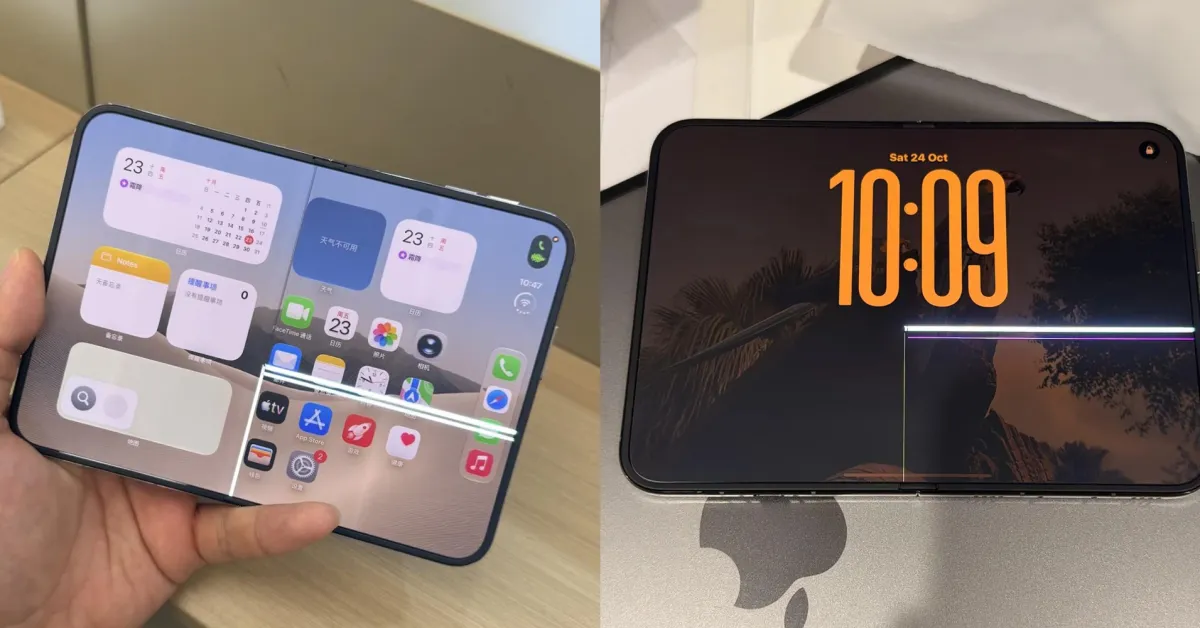
Reports of failing inner screens on early units of Apple’s first foldable device, the iPhone Duo, are surfacing among customers, raising questions regarding the mechanical design of the newly released hardware. The malfunction appears to follow a consistent pattern across multiple affected devices, drawing inevitable comparisons to the early difficulties experienced in the foldable smartphone sector.
Consistent Display Failure Pattern
Users experiencing the issue report that the inner screen fails along the center crease. In several documented instances, the failure begins with a green line running vertically across the right side of the panel, which subsequently progresses into more extensive display damage over time. Customers have also noted physical resistance in the folding hinge prior to the damage occurring, with some reporting an audible cracking sound immediately preceding screen failure.
Unlike previous high-profile foldable device issues that emerged during initial pre-release media evaluation, reports concerning the iPhone Duo emerged after retail shipments reached consumers. The full scale of the issue remains unclear during the ongoing launch period. While early customer service interactions resulted in mixed messaging from support channels, Apple has acknowledged the situation in a statement.
Teardowns Point to Hinge Mechanism
Technical analyses by repair and hardware analysts point to the device’s internal folding assembly as a likely source of the mechanical failure. In an initial assessment, repair specialist iFixit hypothesized that a structural support bar within the hinge mechanism may not be dropping down sufficiently when the phone closes. This mechanical restriction could fail to provide the clearance required by the flexible display, generating a concentrated point of mechanical stress that could cause the panel to crack along the fold.
A separate hardware inspection by a YouTuber identified a similar point of failure inside the hinge assembly. This finding aligns with the hypothesis that physical interference within the folding mechanism may explain why multiple panels are sustaining damage in the exact same physical location.
Parallels to the Original Galaxy Fold
The situation recalls the turbulent launch of Samsung’s original Galaxy Fold in 2019, which suffered widespread screen failures within 48 hours of review units being distributed to journalists. In Samsung’s case, the failures were attributed to two primary factors: consumers inadvertently peeling off a protective top layer that appeared to be a standard screen protector, and external debris penetrating the hinge and damaging the flexible display from underneath.
iFixit’s original 2019 teardown of Samsung’s foldable accurately identified vulnerabilities in the hinge design before the article was temporarily taken down at Samsung’s request. In response to the breakdown of review units, Samsung delayed the Galaxy Fold’s retail release for several months. The company’s chief executive later conceded that the launch had been pushed before the hardware was fully mature, characterizing the setback as embarrassing.
During that postponement, Samsung introduced hardware revisions that tucked the protective layer underneath the outer bezels, added protective caps to the open ends of the hinge to block particulate matter, and integrated reinforcement beneath the flexible display panel. Those adjustments set structural precedents that subsequent foldable devices have broadly adopted.
Uncertainty Surrounding Scope
While Samsung managed its early display crisis prior to broad commercial distribution, Apple’s hardware concerns have surfaced directly in consumer channels following delivery. Industry observers and affected users continue to monitor the situation to establish whether the reported hinge resistance and display fractures represent isolated manufacturing variances or an underlying issue in the first-generation foldable’s physical design.