

Widespread interest in artificial intelligence has largely centered on centralized cloud platforms managed by major technology providers such as OpenAI, Google, Microsoft, and Anthropic. However, growing concerns regarding personal privacy and data ownership have spurred interest in running language models entirely on local desktop hardware. Testing self-hosted environments highlights a computing paradigm where automated agents answer exclusively to the user, bypassing external subscription fees and cloud-hosted data pipelines.
The Appeal of On-Device AI and High-End Hardware
Running artificial intelligence workflows locally eliminates the need to upload sensitive information across external servers. While cloud services routinely ingest files, prompts, and personal details, self-hosted deployments ensure that files never leave the machine. This architectural distinction makes the technology viable for handling confidential records, embargoed product specifications, or private communications that users refuse to entrust to commercial cloud vendors.
Hardware manufacturers are increasingly positioning their premium machines around these local capabilities. Apple has pitched its Mac desktop lineup as well-suited for local AI tasks, while upcoming RTX Spark Windows computers equipped with up to 128GB of RAM are preparing to launch with a dedicated focus on agentic workloads. Dedicated memory remains the primary barrier to entry, as large language models require vast amounts of system memory to load and process data efficiently without relying on paid API tokens.
In testing conducted on an M5 Ultra Mac Studio featuring 256GB of unified memory, users have the rare flexibility to deploy massive open-source models that smaller laptops cannot accommodate. Additional testing plans across the computing spectrum include compact and mobile devices such as the M6 Mac Mini, M5 MacBook Air, and the Asus TUF Gaming A14 powered by an AMD Strix Halo processor, alongside upcoming RTX Spark systems.
Deploying Hermes Agent and Large Qwen Models
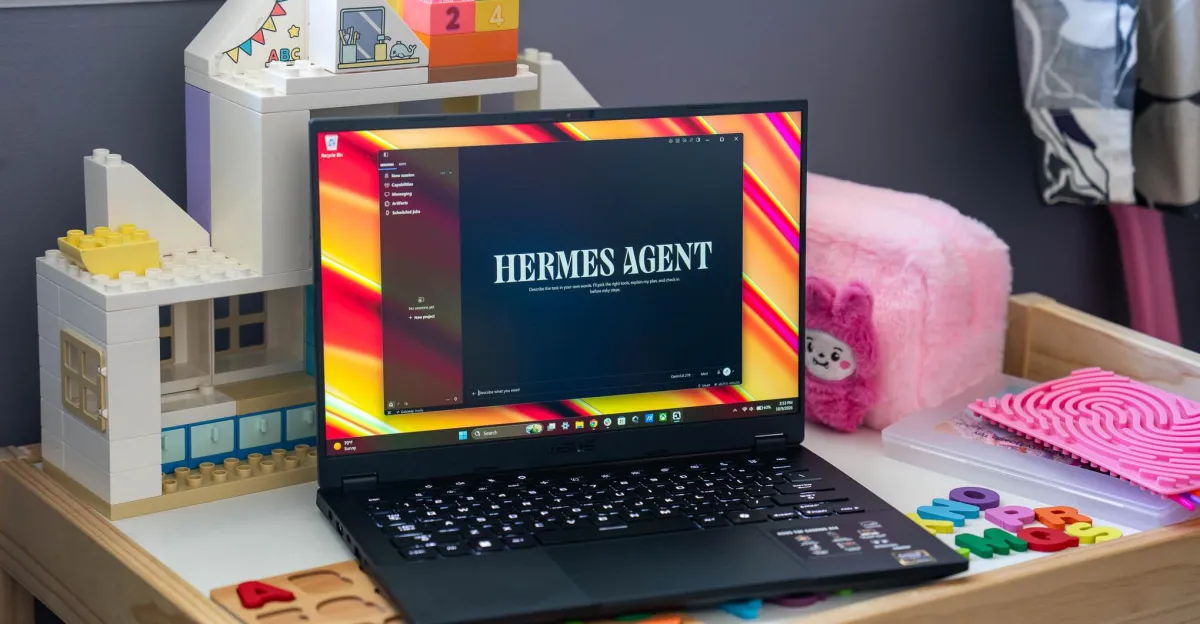
The foundation of a self-hosted agent relies on software capable of orchestrating model actions across the local operating system. Testing centered on Hermes Agent, an open-source, self-hosted desktop application compatible with macOS, Windows, and Linux. The software is free to operate when paired strictly with local models and features an onboarding flow with an integrated model picker.
Given the 256GB unified memory ceiling of the Mac Studio, testing utilized the Qwen 3.8 Flash Next model, a 125-billion parameter architecture that occupies roughly 105GB of disk and memory footprint. While larger parameter counts generally offer more capable reasoning than compact models with only a few billion parameters, sorting through the vast quantity of specialized open-source models can quickly become overwhelming. Once configured, Hermes was linked to a Telegram bot, enabling direct interaction and remote command control from a smartphone.
Real-World Testing: From Daily Briefs to Steam Libraries
Despite the sophisticated underlying architecture, early experiments demonstrate that putting a local agent to work still involves confronting the familiar blank prompt box. Early configuration focused on routine utility tasks, starting with an automated morning briefing scheduled via cron jobs. The setup was tasked with scanning calendars and emails, summarizing urgent priorities, and fetching local weather reports. Initial attempts repeatedly failed until it became apparent that macOS could not be in a sleep state when the 7:30 a.m. task triggered. Once system sleep settings were addressed, the automated brief ran dependably, though expanding its everyday usefulness requires continuing adjustments.
A more tangible application involved sorting an unorganized Steam library consisting of more than 400 titles. Because the Steam client does not automatically categorize extensive game collections, the process typically demands manual intervention. To allow Hermes to act, the agent required specific operating system permissions and a registered Steam web API key. Inspecting the local Steam installation, the agent proposed genre classifications while preserving pre-existing custom groups such as favorites, cooperative games, party titles, and two-player games. The agent cataloged the library in minutes, after which the temporary API key was promptly revoked to preserve security.
Local models also proved advantageous for processing embargoed hardware specifications and running numerical analysis on personal financial records. Because these tasks handled confidential data that could not be uploaded to remote services, local computation served as the sole reason the analysis could be performed using AI tooling.
Current Limitations and Automation Development
While basic sorting and single-file analysis operate reliably, broader agentic automation remains an active work in progress. Ongoing development involves prompting Hermes to generate Python scripts that can automate repetitive laptop performance benchmarking. Running dozens of standardized benchmark runs three times to establish reliable averages is labor-intensive, but guiding the agent through vibe-coded script generation has proven challenging.
Practical testing reinforces that current local models do not operate as effortless, general-purpose assistants. Automated jobs can fail unexpectedly, requiring continuous technical vigilance. Rather than treating local agents as interactive digital companions, the workflow functions best when approached as standard, functional system software directed strictly through mechanical commands.