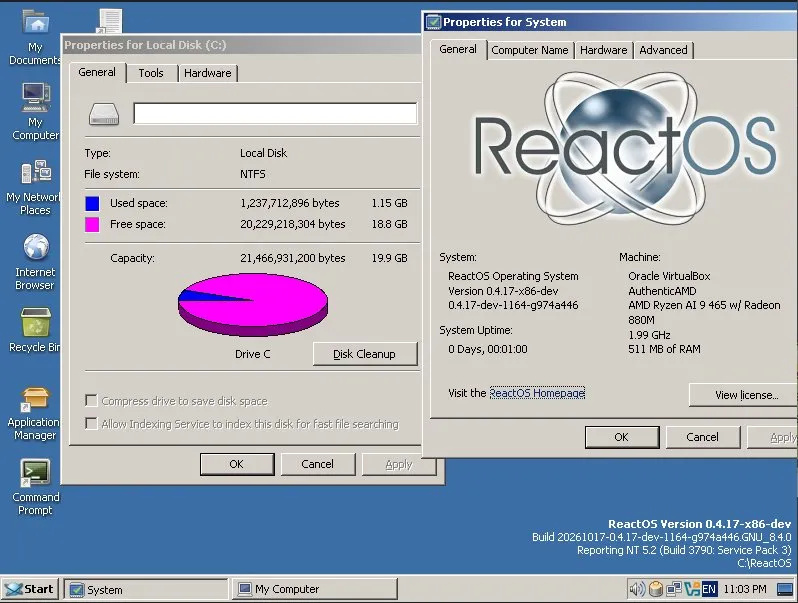
ReactOS, the long-running open-source project aimed at creating a free and open-source alternative to Microsoft Windows, has achieved a critical technical milestone: the operating system can now be installed directly onto an NTFS drive partition.
As reported by Phoronix, the introduction of this new file system driver eliminates a long-standing architectural obstacle for the project, pushing the operating system one step closer to transitioning out of its extended alpha phase and into a formal beta release.
Moving Past the FAT32 Limitation
Prior to this development, users running ReactOS were constrained to using FAT32 partitions for OS installations. This restriction created a significant practical and structural barrier for the platform. ReactOS maintains a stated engineering goal of achieving binary compatibility with Windows Server 2003, aiming to run applications and drivers built for the Microsoft ecosystem without modification. Because the modern Windows architecture has long standardized on NTFS, remaining confined to FAT32 stood in stark contrast to reproducing a realistic Windows environment.
NTFS, a proprietary file system created by Microsoft, traces its origins back to the launch of the Windows NT family in 1993 with Windows NT 3.1. The updated variant introduced alongside Windows XP in 2001 set the foundation that modern desktop and server releases of Windows still rely on today.
A Decade-Long Development Road
Enabling full installation support on NTFS addresses a gap in the project’s roadmap that spanned nearly a decade. Read-only NTFS capability was initially implemented into ReactOS back in 2016. Years later, in 2022, boot support was integrated into FreeLoader, the project’s bootloader. While FreeLoader allowed the system to boot and read data from an NTFS drive, users remained unable to perform an installation directly to an NTFS volume until the rollout of the latest driver.
Performance Warnings and Early Limitations
Despite the achievement, the ReactOS development team advised caution for early adopters and hobbyists looking to test the feature. The team acknowledged that the newly introduced driver is not yet feature-complete.
According to ReactOS developers, the current implementation lacks caching mechanisms, which leads to inferior disk performance. It also currently operates without journaling capabilities and lacks security support. In an announcement shared on X, the ReactOS team further warned that users should expect potentially undiscovered bugs as testing widens.
Community-Driven Engineering
ReactOS remains an independent, community-developed effort that describes its progress as mostly driven by volunteers. Development tasks, bug tracking, and code reviews are managed through public collaboration channels, including GitHub and the project’s dedicated discussion forums.
The extensive timeline required to deliver native NTFS installation underscores the monumental challenge of reverse-engineering and reimplementing an enterprise-grade operating system from the ground up without proprietary code. While questions remain over whether ReactOS will ever become a daily-driver replacement for contemporary Windows for the general public, the arrival of direct NTFS installation ensures that the open-source platform can finally reside on the very file system that defined modern PC computing.