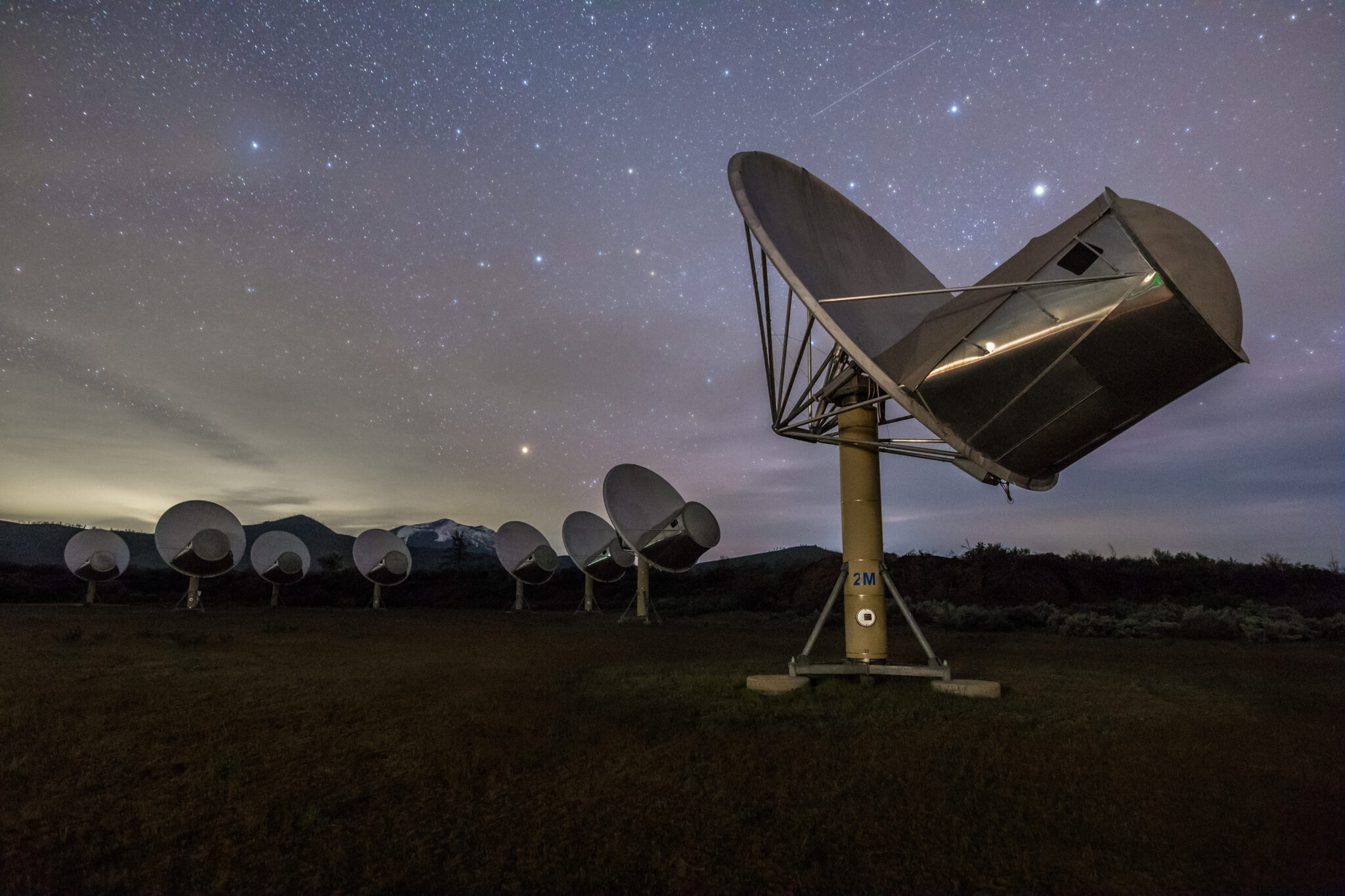
Astronomers searching for signs of intelligent extraterrestrial life are turning to autonomous artificial intelligence agents to manage the deluge of radio data pouring in from deep space. Through a collaboration between Breakthrough Listen and the SETI Institute, agentic AI systems have been integrated into daily operations at the Allen Telescope Array in Northern California.
The system allows autonomous software agents to steer telescope antennas, calibrate and focus instruments for clearer reception, detect and correct incoming data anomalies, and run analytical models across data streams. Rather than relying on rigid manual control scripts, scientists can direct these workflows through single natural language requests.
Real-Time Ingest and In-Flight Processing
Radio observatories capture vast quantities of observational data, presenting a longstanding computational bottleneck for researchers attempting to flag anomalies before data storage limitations force difficult trade-offs. To address this, the Allen Telescope Array has implemented an infrastructure powered by NVIDIA Holoscan and GPU acceleration.
At the center of this pipeline is DAQIRI, a library built on the Holoscan platform that streams sensor data directly into graphics processing unit memory at terabits per second. By bypassing traditional storage drives during initial collection, the pipeline processes observations in flight. Signal processing and mathematical computations are handled by CyberEther, a framework engineered by the SETI Institute that leverages NVIDIA CUDA-X libraries, including cuFFT and cuBLAS.
Hardware orchestration takes place locally next to the antenna dishes, where an array of NVIDIA RTX PRO 6000 Blackwell GPUs handles throughput reaching 2.4 terabits per second. Running inference on-premises directly alongside the telescope allows the system to process incoming observations with minimal latency.
Harnessing Agents with Natural Language
Coordination across the observatory’s instrument state, computational clusters, and analysis pipelines is managed by Nexus, a web-based orchestrator designed as an agent harness. Nexus provides autonomous agents with a unified operational environment, serving as a single source of truth for the entire facility.
Human researchers use the platform to prompt agents using everyday conversational language. In turn, the agents monitor network health, identify packet loss, parse live spectrograms, and dynamically alter signal-processing blocks. Tasks that historically required weeks or years of human monitoring and post-processing can now be executed by agentic workflows in hours.
The pipeline demonstrated operational viability during testing when it achieved the first real-time AI detection of a pulsar located in the Crab Nebula, correctly identifying the rapidly rotating stellar remnant’s regular pulses.
Listening for Non-Human Technology
The turn toward autonomous systems also reflects evolving theoretical perspectives within astrobiology and observational astrophysics. If extraterrestrial civilizations exist, scientists reason that some could be billions of years older than human civilization. Such ancient societies would have had ample time to develop advanced technologies, including machine intelligence.
Consequently, the search for technosignatures is increasingly envisioned as artificial intelligence built by humans scanning the cosmos for transmissions that may originate from alien machine intelligence rather than biological entities.
“As our new agentic observatories reach out into the universe, what they find may have much more in common with themselves than with the humans who created them,” said Andrew Siemion, Bernard M. Oliver chair for SETI at the SETI Institute and principal investigator of Breakthrough Listen. “But this isn’t something to fear. Rather, it’s a breakthrough in translation.”
Evaluating Future Deployments
Following the successful pulsar detection at the Allen Telescope Array, project researchers are testing additional open architectures, including NVIDIA Nemotron models. The team is focusing on scenarios requiring local processing resilience and rapid analytical turnaround.
Researchers note that these lightweight, local agentic models could eventually prove essential for future off-world installations, including theoretical radio observatories deployed on the far side of the moon, where communications latency with Earth would make completely autonomous instrument management a necessity.