


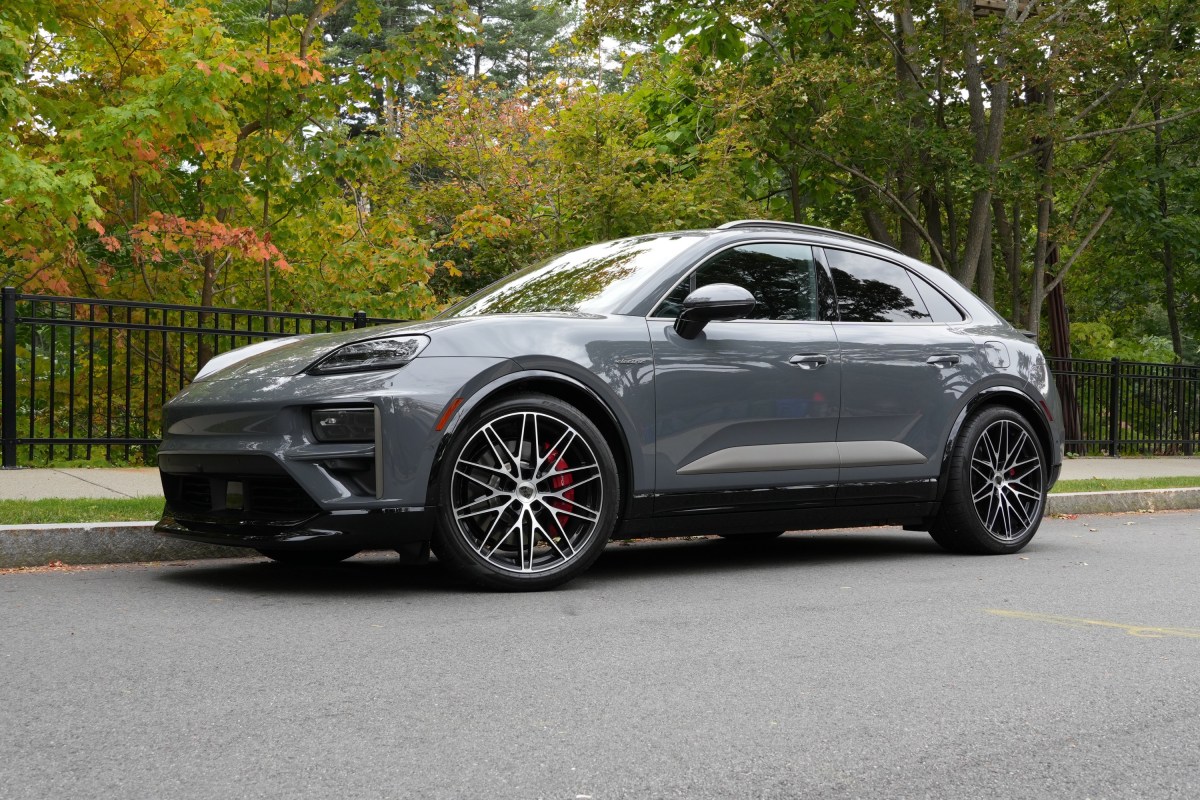
In contemporary automotive design, extreme performance rarely arrives in quiet packaging. Yet the 2026 Porsche Macan Turbo electric vehicle presents an unusual balance: an electric crossover that conceals violent acceleration beneath a restrained, conventional silhouette. Finished in Slate Grey Neo, a $2,620 paint option, the electric crossover navigates city streets and school pickup lines without drawing the stares or gathering the enthusiast crowds typically attracted by high-performance vehicles from Stuttgart.
The vehicle’s unassuming visual profile raises fundamental questions about what defines a modern sports car. Featuring a slightly bulbous roofline and standard two-row proportions, the Macan Turbo EV looks noticeably less extroverted than its gasoline-powered predecessors. However, the disconnect between its humdrum crossover appearance and its mechanical capabilities disappears the moment the throttle is engaged.
Supercar Acceleration in an Everyday Form Factor
Underneath its understated sheet metal, the 2026 Macan Turbo EV houses an electric powertrain generating 630 horsepower, fed by a 100-kilowatt-hour battery pack. The resulting acceleration delivers intense physical force. Stamping the throttle at 70 mph produces an immediate surge forward, and the head-up display—a $2,660 optional extra—reports pronounced G-forces that mimic the sensation of rapid gravitational pull.
Dynamic capability extends beyond straight-line speed. Unlike standard high-riding utility vehicles where the driver sits perched high above the chassis, the Macan provides a low, engaged driving posture where the driver feels seated within the vehicle. The steering column extends sufficiently outward to enable an authentic sports-car driving position, complemented by the classic Porsche analog chronometer mounted centrally on the dashboard, which adds $1,040 to the invoice.
Handling agility on winding roads is significantly enhanced by optional four-wheel steering, priced at $2,150. Engaging Sport Plus mode triggers the adaptive air suspension to lower the vehicle’s ride height, sharpening chassis responses and eliminating body roll. Through tight corners, the crossover behaves far more like a dedicated performance machine than an everyday family hauler.
The Options Sheet and Six-Figure Pricing
Performance of this caliber commands a steep financial entry point. The 2026 Porsche Macan Turbo EV carries a starting base price of $112,700. However, the evaluation vehicle tested reached a total retail price of $149,610 after factoring in destination fees and extensive factory equipment options. The price difference between the base model and the tested build alone matches the purchase price of an entire entry-level mass-market electric car.
A review of the window sticker demonstrates Porsche’s familiar approach to optional equipment. Among the interior features is a $1,710 front passenger display capable of streaming media such as YouTube videos. Secondary visual embellishments include puddle lamps projecting the brand name onto the pavement for $420, headrests embossed with Porsche crests for $640, illuminated brand lettering along the front seatbacks for $690, and illuminated door sills bearing the Turbo insignia for $1,230.
While branding an electric vehicle with a “Turbo” moniker continues to generate debate among purists who point out that electric motors do not feature exhaust-driven turbines, the designation reflects Porsche’s established trim hierarchy rather than mechanical reality—a convention long accepted across the automotive industry.
Range, High-Speed Charging, and Cabin Ergonomics
In terms of core electric capability, the Macan Turbo demonstrates strong charging performance and respectable highway endurance. Equipped with upgraded wheels priced at $4,110 and sticky performance tires at $660, the crossover delivers roughly 285 miles of highway driving range. During evaluations, this capacity provided sufficient energy to complete a trip between New York and Boston without charging anxiety.
Replenishment speeds are similarly competitive. Connected to a 350-kilowatt DC fast charger, the vehicle accepted energy at a peak rate of 245 kilowatts—approaching its theoretical maximum ceiling of 270 kilowatts. Under these test conditions, the battery charged from 19 percent state of charge to 80 percent in exactly 20 minutes.
Everyday operation yields mixed technological impressions. The vehicle provides the modern convenience of walk-away locking, while retaining a legacy push-button start located to the left of the driver’s display for brand traditionalists. An optional $4,960 Burmester audio system provides high-fidelity sound, and the $1,140 advanced driver assistance system handles automated driving tasks capably, despite exhibiting occasional lane-hunting tendencies. Voice commands operated accurately via an integrated AI assistant, which reliably engaged cabin systems such as the $720 heated steering wheel—a feature controlled alternatively by a discreet physical toggle concealed on the steering wheel’s inner rim.
Software and EV Navigation Quirks
Where the Macan Turbo EV faltered during testing was its integrated route-planning and charging navigation. When the vehicle was depleted to a 22 percent state of charge, a voice request to route to the nearest fast charger produced an illogical, two-step itinerary. Rather than routing to a single destination, the navigation directed the driver to a 50-kilowatt stall in a mall parking lot to add a minimal charge, followed by instructions to immediately unplug and drive across the street to a separate 350-kilowatt station.
When the driver ignored the intermediate stop and routed directly to the high-output 350-kilowatt charger, arriving at 19 percent, the vehicle continued instructing a diversion until reversing into the charging stall. While this behavior may stem from conservative factory battery-preservation parameters, the multi-step algorithm represents a notable flaw in native software usability.
Ultimately, the electric Macan Turbo represents the modern evolution of the performance crossover. By wrapping 630 horsepower and rapid charging hardware in a stealthy, understated crossover shape, Porsche has built a machine that blurs the technical boundary between everyday family transport and high-performance engineering.