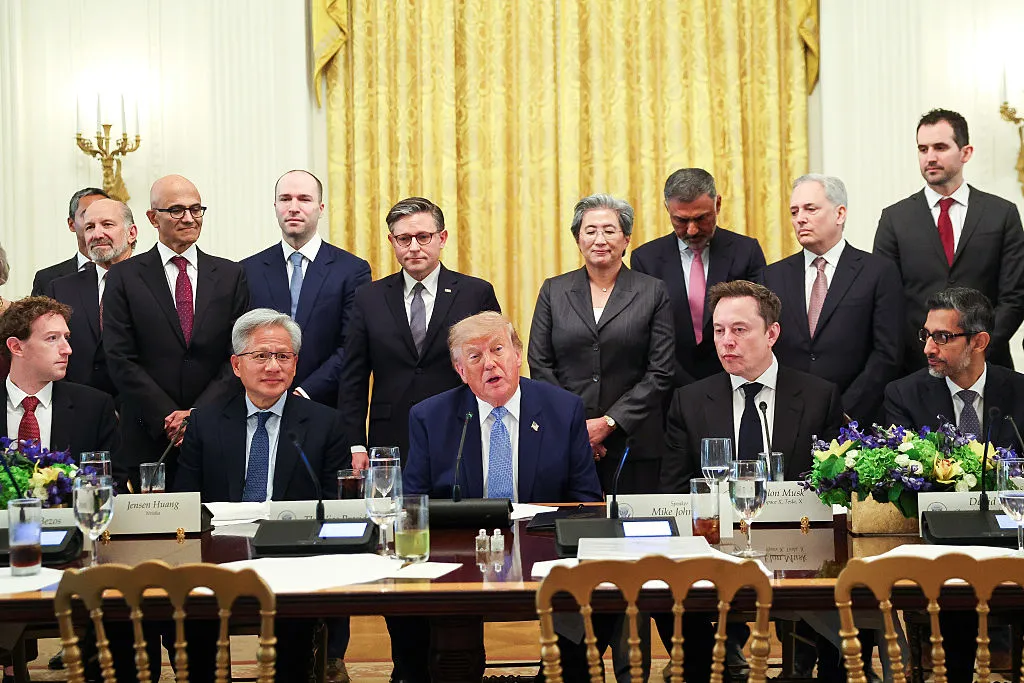
The White House has introduced a new official terminology for artificial intelligence, directing US federal agencies to use the term “Super Intelligence” instead of “Artificial Intelligence” in government communications. The move follows a high-level meeting between President Donald Trump and executives from some of the world’s largest technology companies, where discussions focused on AI development, safety measures and America’s position in the global technology race.
The policy was formalised through an executive order signed by Trump on September 29, 2026, titled Inaugurating the Era of Super Intelligence. Under the directive, the administration wants federal agencies to replace the terms “Artificial Intelligence” and “AI” with “Super Intelligence” and “SI” in official correspondence, public communications, websites, reports and policy documents, where legally permitted.
The announcement has attracted attention across the technology industry because artificial intelligence has been the established name for the field for decades. The administration’s decision also raises questions about whether technology companies and other institutions will adopt the new terminology.
Trump Administration Introduces the Term Super Intelligence
President Donald Trump has argued that the phrase “Super Intelligence” better represents the growing capabilities of modern AI systems.
According to the executive order, today’s advanced AI technologies are increasingly capable of supporting human creativity, improving productivity and contributing to developments in areas such as science and medicine.
The administration believes that the traditional term artificial intelligence does not fully communicate the potential of increasingly sophisticated systems. It has therefore directed executive branch agencies to adopt the alternative terminology in their official communications.
The order defines “Super Intelligence” and “SI” using the existing federal statutory definition of artificial intelligence. This means the terminology changes, but the underlying legal scope initially remains connected to the existing definition.
The White House has also instructed the Assistant to the President for Science and Technology to prepare proposed legislative language within 60 days. The proposal is expected to examine whether a new federal definition should modify, expand or replace the existing statutory definition of artificial intelligence.
High-Level Technology Summit Brings Major AI Executives Together
The terminology announcement followed a September 29 White House gathering involving senior representatives from leading technology companies.
The meeting included executives associated with OpenAI, Anthropic, Google, Meta, Nvidia and xAI. The discussions focused on the responsibilities of companies developing advanced AI models and the need for safeguards as these systems become more capable.
During the gathering, participating companies signed a voluntary industry agreement outlining several proposed safety and oversight measures.
The agreement focuses on four major areas:
Internal monitoring: Companies are expected to monitor the capabilities and behaviour of their AI models during development and deployment.
Dedicated oversight teams: Participating organisations are expected to establish internal teams responsible for supervising safety procedures.
-
Independent external audits: Companies are encouraged to work with outside auditors to assess their safety measures.
Board-level supervision: Independent committees are expected to review reports from internal teams and external auditors.
The agreement is intended to encourage companies to take greater responsibility for identifying and addressing risks associated with advanced AI systems.
However, the framework is voluntary and does not establish a comprehensive federal regulatory system for the industry.
Technology Companies Face Questions Over the New Terminology
The White House’s decision to promote “Super Intelligence” has created discussion within the technology sector.
Although major technology executives participated in the summit and signed the voluntary agreement, their attendance does not necessarily mean that their companies have formally adopted the new terminology across products, research and public communications.
Artificial intelligence remains the widely recognised technical term used by researchers, developers, universities and businesses. The phrase also has a long-established history within computer science.
The term “superintelligence” already has a separate meaning in AI research. It generally describes a hypothetical level of machine intelligence that could substantially exceed human cognitive abilities across a wide range of tasks.
This distinction has led to questions about whether using “Super Intelligence” as a replacement for the broader term artificial intelligence could create confusion.
Some technology leaders have publicly used the administration’s preferred wording, while other organisations and officials have indicated that they will continue using the established terminology.
California Pushes Back Against the Federal Rebranding
The proposed terminology change has also received a response from state-level officials.
California Governor Gavin Newsom announced that state agencies would continue using the terms “Artificial Intelligence” and “AI” rather than adopting the federal government’s preferred wording.
His position highlights the difference between federal executive branch communications and terminology used by individual state governments.
The White House executive order directs federal agencies to follow the new terminology in relevant official materials, but it does not automatically require every private company, university or state government to change its language.
As a result, different government institutions and technology organisations may continue using different terminology when discussing the same technology.
White House Establishes a Super Intelligence Force
The administration’s broader effort to reshape its approach to advanced AI also includes the formation of a federal task force called the Super Intelligence Force.
On October 4, 2026, Trump announced that National Intelligence Director Jay Clayton would lead the initiative. Other officials named to the group include Federal Trade Commission Chairman Andrew Ferguson, Pentagon technology official Emil Michael and Office of Personnel Management Director Scott Kupor.
The task force is intended to coordinate federal efforts relating to advanced AI development, national security and technological competitiveness.
It is also expected to examine opportunities and potential threats associated with increasingly capable AI systems. Reports indicate that the group has been given 120 days to prepare an assessment of the risks and opportunities.
The initiative reflects the administration’s intention to coordinate AI-related policy across government departments while maintaining the country’s position in the international technology competition.
What the Rebranding Means for the Future of AI Policy
The decision to replace “Artificial Intelligence” with “Super Intelligence” in federal communications represents a change in government terminology rather than an immediate transformation of the technology itself.
AI developers will continue building and deploying systems using existing research methods, technical standards and development frameworks. The executive order primarily affects how the federal executive branch describes these technologies in official materials.
However, the administration’s request for proposed legislative language could eventually lead to a broader discussion about how advanced AI systems should be defined under federal law.
The distinction may become increasingly important as governments address issues involving AI safety, cybersecurity, privacy, employment and national security.
Technology companies will also need to consider how voluntary safety agreements, government expectations and existing legal requirements interact as AI capabilities continue to develop.
Conclusion
The White House’s decision to rebrand artificial intelligence as “Super Intelligence” marks a notable shift in the Trump administration’s technology messaging following its September 2026 summit with major technology executives.
Through Executive Order 14434, the administration has directed federal agencies to use the terms “Super Intelligence” and “SI” in place of the established terminology wherever legally permitted. The accompanying industry agreement also encourages participating technology companies to strengthen internal monitoring, independent audits and executive oversight.
However, the new terminology has not replaced artificial intelligence as the universally accepted technical term. Differences between federal and state approaches, along with questions about the meaning of superintelligence in scientific research, are likely to keep the debate active.